Faith, Leadership, and Legacy in Gospel Music Ministry | Part 2
Building Sustainable Ministries in the Digital Age
Part 2 of 4: Leadership — Moving Beyond the Artist Mindset

Executive Summary
Many independent Gospel artists begin their journey focused on music creation, songwriting, recording, and performance. While artistic excellence remains important, sustainable ministry growth requires a transition that many creators never fully make: moving from the mindset of an artist to the mindset of a leader.
Leadership in Gospel music ministry extends beyond creating songs and building audiences. It involves stewardship, vision casting, decision-making, team development, resource management, community building, and preparing future leaders. Ministries that remain dependent upon a single individual often struggle to scale, adapt, and sustain long-term impact.
This publication explores the leadership responsibilities required to build sustainable Gospel music ministries in the digital age. It examines the differences between artists and leaders, the importance of developing ministry infrastructure, and the role of servant leadership in creating lasting Kingdom influence.
Introduction
Talent may open doors.
Leadership determines what happens after those doors open.
Many Gospel artists spend years developing their musical abilities but invest comparatively little time developing leadership skills. This imbalance often becomes apparent as opportunities increase.
A successful song release may generate new listeners.
A podcast interview may attract new supporters.
A viral social media post may increase visibility.
Yet none of these developments automatically create a sustainable ministry.
Growth introduces complexity.
Complexity requires leadership.
The ministries that create long-term impact typically transition from personality-driven operations to mission-driven organizations.
The question becomes:
How does a Gospel artist evolve into a Gospel ministry leader?
For additional perspective, consider linking internally to:
Kingdom-centered music ecosystem
Devine Jamz Gospel Network: Building a Kingdom-Centered Independent Music Marketing Ecosystem
The Difference Between an Artist and a Leader
Artists and leaders share many qualities.
Both communicate vision.
Both influence people.
Both inspire action.
However, their primary responsibilities differ.
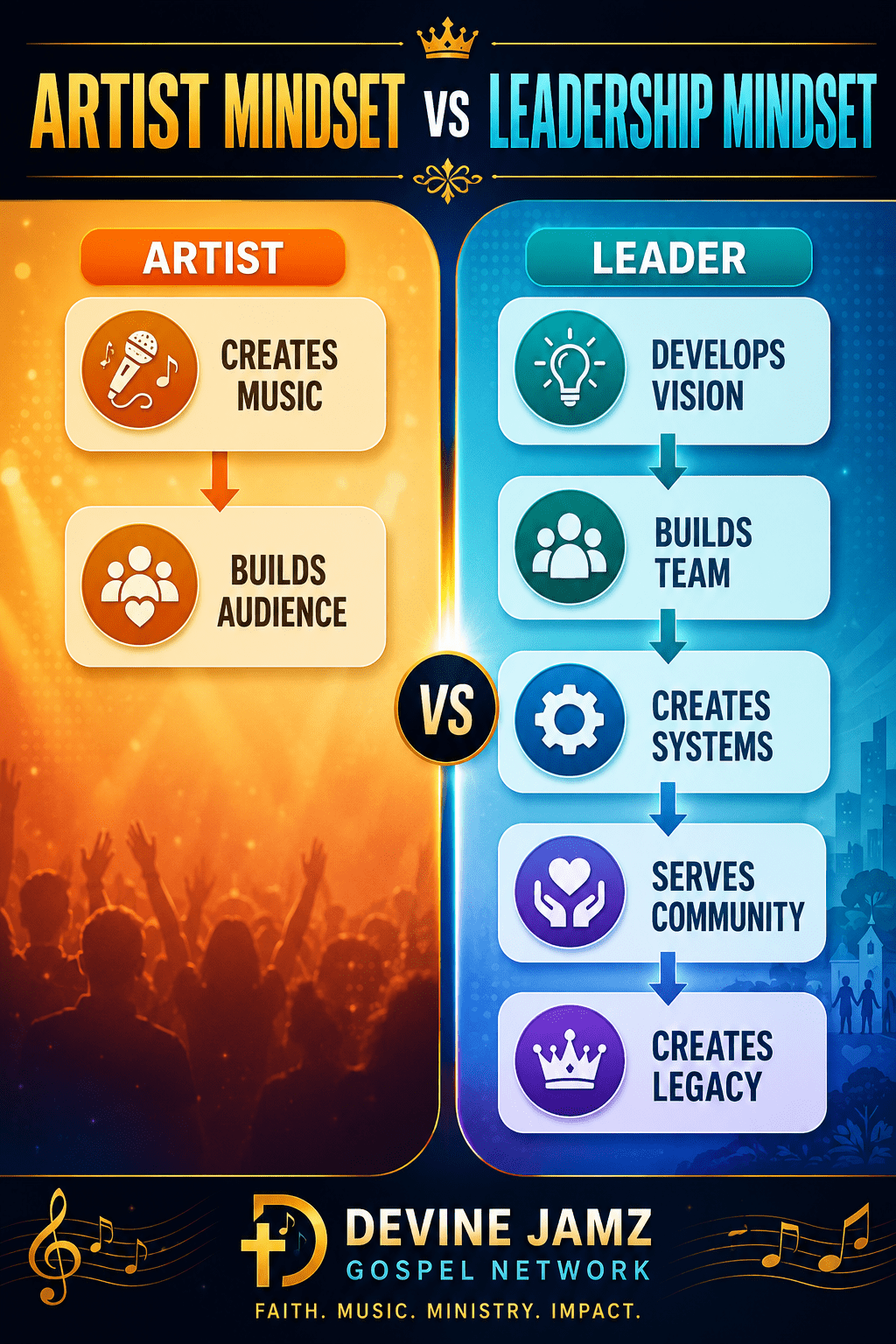
Artist Mindset
The artist mindset often focuses on:
- Song creation
- Recording projects
- Personal expression
- Creative output
- Performance opportunities
These activities are important.
However, they typically center around what the artist produces.
Leadership Mindset
Leadership expands the focus.
Leaders think about:
- Mission
- Vision
- Teams
- Systems
- Relationships
- Sustainability
- Future growth
Leadership asks:
- Who are we serving?
- What are we building?
- How can others contribute?
- How do we sustain this mission?
Artists create content.
Leaders build environments where ministry can flourish.
Why Many Ministries Plateau
Many ministries experience early growth.
They release music.
They gain followers.
They receive opportunities.
Then growth slows.
Often the issue is not talent.
The issue is infrastructure.
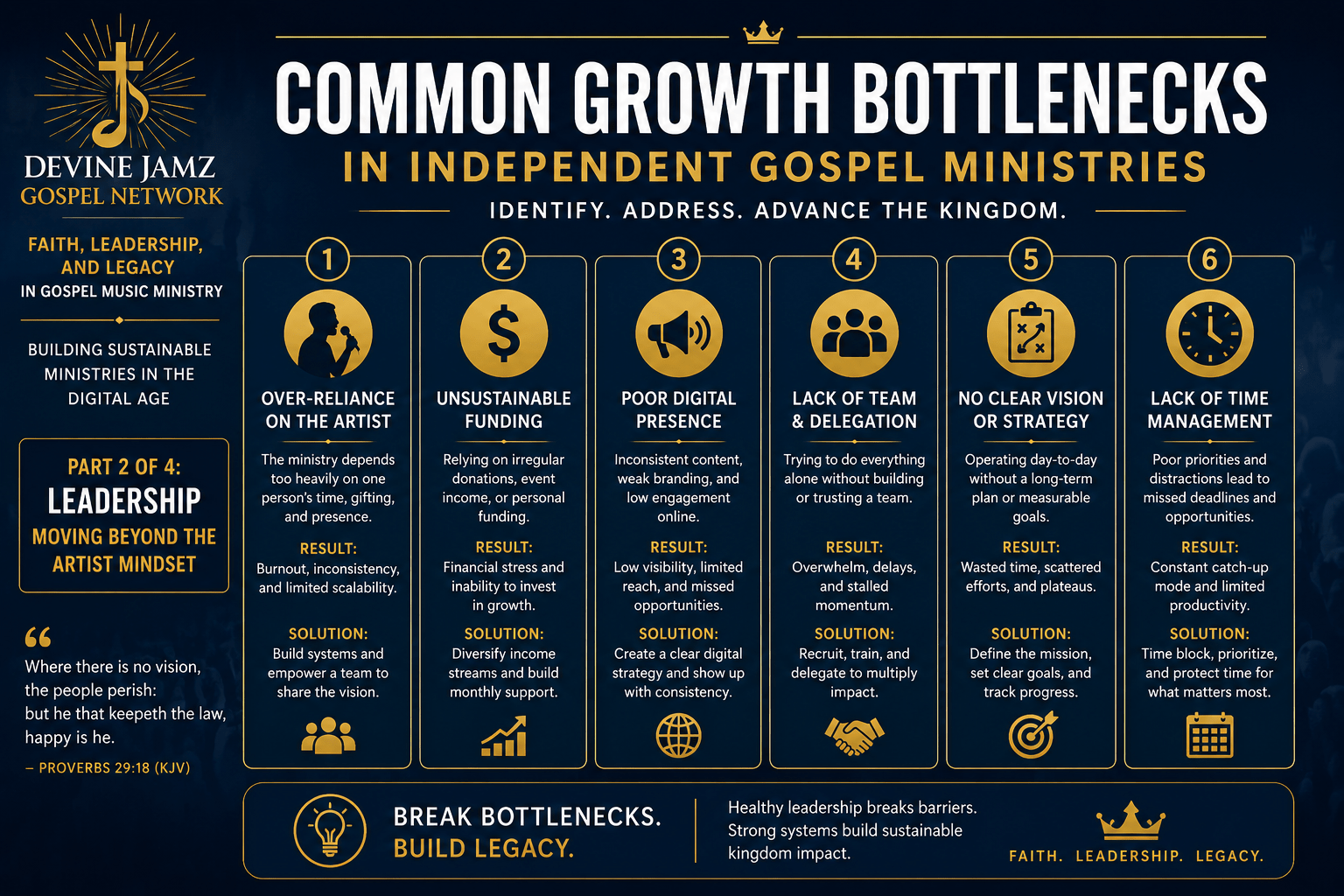
Growth without leadership creates bottlenecks.
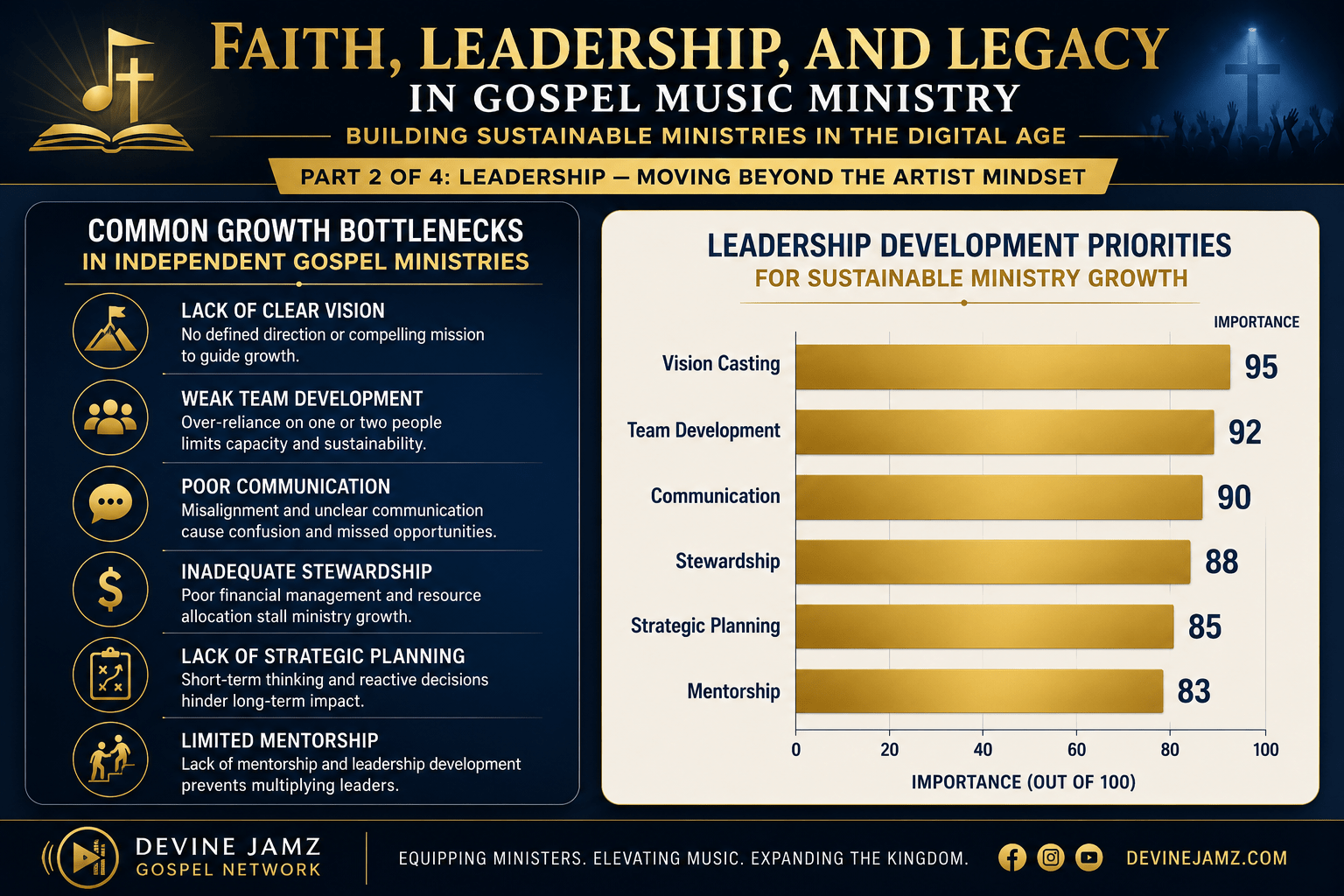
Common ministry bottlenecks include:
Decision Bottlenecks
One person makes every decision.
Content Bottlenecks
One person creates all content.
Communication Bottlenecks
One person manages all relationships.
Administrative Bottlenecks
One person handles all logistics.
Eventually capacity is reached.
The ministry stops growing because leadership systems have not developed alongside visibility.
For additional perspective, consider linking internally to:
Ultimate Gospel Artist Blueprint: Organic Growth, Branding & Digital Marketing Success | Part 1 of 3
The Biblical Model of Leadership
Scripture consistently presents leadership as stewardship rather than status.
Jesus demonstrated servant leadership.
His influence was built upon service rather than position.
This principle remains highly relevant in today’s ministry environment.
Effective Gospel music leaders:
- Serve first
- Empower others
- Develop future leaders
- Build healthy cultures
- Protect the mission
Leadership is not about control.
Leadership is about responsibility.
Key Scripture References
- Mark 10:45
- Matthew 20:26–28
- Ephesians 4:11–13
- 1 Peter 4:10
- Proverbs 11:14
Leadership in the Digital Mission Field
The digital landscape requires leaders to think differently.
Today’s ministry leaders oversee:
- Websites
- Social media
- Podcasts
- Email communication
- Video content
- Community engagement
- Partnerships
- Analytics
Technology creates opportunities.
Leadership determines how those opportunities are stewarded.
The most sustainable ministries develop systems that allow their message to reach audiences consistently while maintaining authenticity.
For additional perspective, consider linking internally to:
Ultimate Gospel Artist Blueprint: Organic Growth, Branding & Digital Marketing Success | Part 2 of 3
Building Teams Instead of Building Dependency
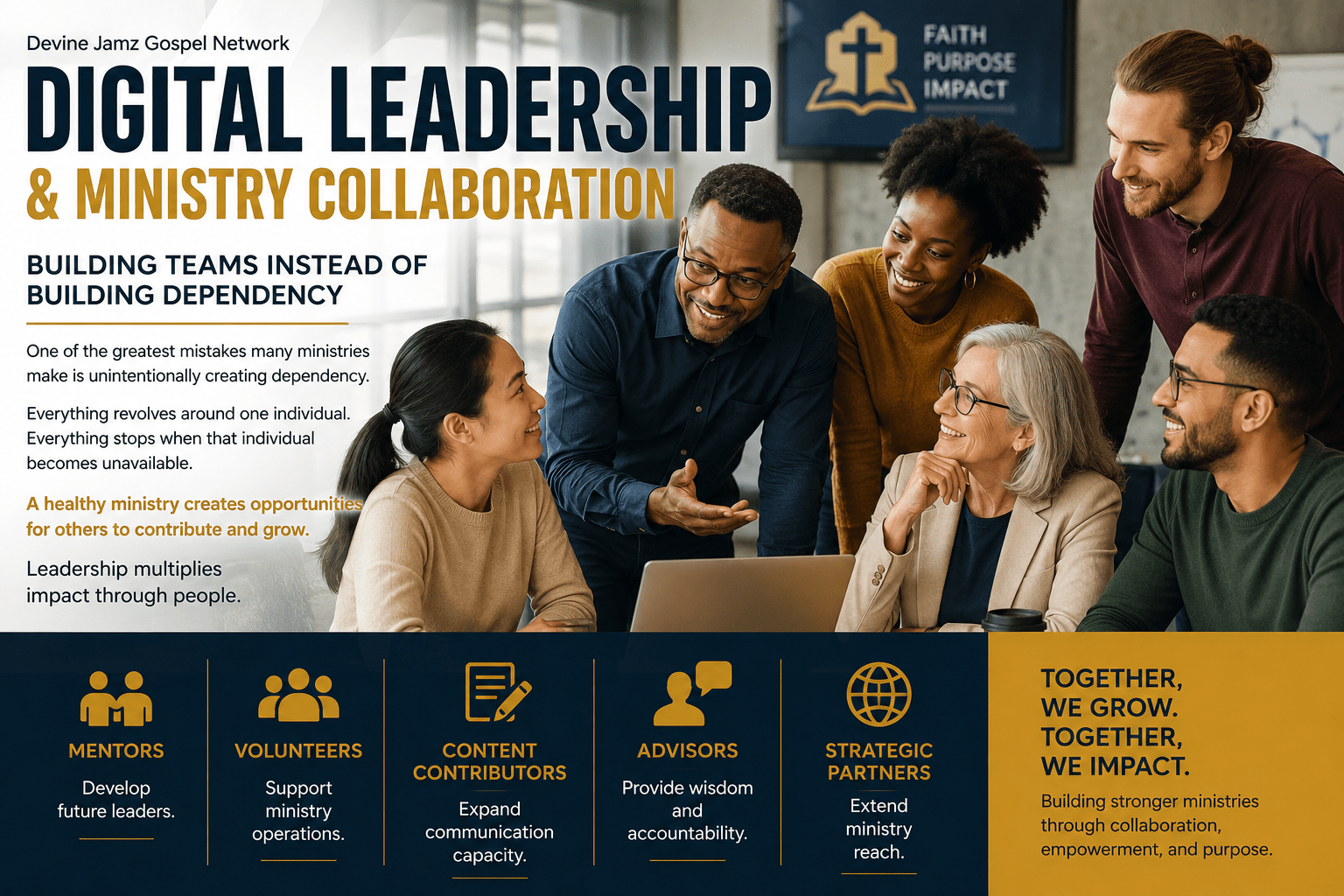
One of the greatest mistakes many ministries make is unintentionally creating dependency.
Everything revolves around one individual.
Everything stops when that individual becomes unavailable.
Sustainable ministries develop people.
Examples include:
Mentors
Develop future leaders.
Volunteers
Support ministry operations.
Content Contributors
Expand communication capacity.
Advisors
Provide wisdom and accountability.
Strategic Partners
Extend ministry reach.
A healthy ministry creates opportunities for others to contribute and grow.
Leadership multiplies impact through people.
For additional perspective, consider linking internally to:
Partnership And Volunteer Opportunities At Devine Jamz Gospel Network
Leadership Development as a Ministry Strategy
Many organizations treat leadership development as an optional activity.
Sustainable ministries view leadership development as a strategic priority.
Leadership development includes:
- Mentorship
- Training
- Delegation
- Documentation
- Accountability
- Succession planning
These activities may not generate immediate visibility.
However, they create long-term stability.
Ministries that invest in leadership development are often better positioned to navigate growth, transitions, and future challenges.
Leadership and Legacy
Legacy is rarely built through a single event.
Legacy develops through years of consistent leadership.
The most influential ministries often share common characteristics:
- Clear vision
- Strong values
- Healthy culture
- Leadership development
- Community investment
- Long-term thinking
Legacy represents the cumulative impact of leadership over time.
It is the result of decisions made consistently over many years.
For additional perspective, consider linking internally to:
Ultimate Gospel Artist Blueprint: Organic Growth, Branding & Digital Marketing Success | Part 3 of 3
Conclusion
Many Gospel artists begin with a desire to create music.
Sustainable ministry leaders eventually realize they are building something much larger.
They are building communities.
They are developing leaders.
They are creating systems.
They are stewarding opportunities.
Most importantly, they are helping advance a mission that extends beyond themselves.
Leadership serves as the bridge between faith and long-term impact.
Without leadership, vision remains unrealized.
Without leadership, growth becomes difficult to sustain.
Without leadership, legacy becomes unlikely.
As ministries mature, the next challenge emerges:
How do leaders create infrastructure capable of supporting long-term ministry growth?
That question becomes the focus of Part 3.
Coming Next
Part 3 of 4
Infrastructure: Building Systems for Long-Term Ministry Growth
How sustainable ministries use systems, technology, documentation, communication, and organizational structure to create lasting Kingdom impact.
External References
- Pew Research Center
- Independent research on religion, faith communities, media consumption, technology adoption, and societal trends.
- Edison Research
- Research on podcasting, audio consumption, digital media behavior, and audience engagement trends.
- IFPI Global Music Report
- Global music industry statistics, streaming trends, consumer behavior, and recorded music market insights.
- YouTube Creator Academy
- Educational resources related to content creation, audience development, video strategy, and digital publishing.
- Music Business Worldwide
- Music industry news, market analysis, artist development trends, and business insights.
- Deloitte Insights
- Research covering digital transformation, media consumption, leadership, organizational growth, and technology trends.
- McKinsey & Company Insights
- Research on leadership, organizational development, innovation, strategy, and long-term sustainability.
- Spotify for Artists
- Educational resources on streaming, audience analytics, release strategies, and fan engagement.
- Google Trends
- Search trend analysis and audience interest research relevant to Gospel music and ministry topics.
- Meta Business Resources
- Resources related to audience engagement, content strategy, community building, and digital communication.
Scripture References
- Proverbs 3:5–6
- Matthew 6:33
- Matthew 20:26–28
- Mark 10:45
- Colossians 3:23
- Ephesians 4:11–13
- 1 Peter 4:10
- Proverbs 11:14
Citation Statement
Research, industry observations, and supporting data referenced throughout this publication were compiled from publicly available reports, educational resources, industry publications, leadership studies, media research organizations, and biblical references available at the time of publication.
Disclaimer & Transparency Notice
This publication may contain affiliate links. Devine Jamz Gospel Network may earn a commission if you purchase products or services through links referenced in this publication at no additional cost to you.
This publication was created with the assistance of Artificial Intelligence (AI) technology. While reasonable efforts have been made to review and edit the content, AI-generated information may contain inaccuracies, omissions, outdated information, or interpretations that are not entirely accurate. Readers are encouraged to independently verify all facts, statistics, references, research findings, and claims before making decisions based upon this content.
The views and opinions expressed are solely those of Devine Jamz Gospel Network and are provided for educational, informational, and research purposes only.