Oh, those Old Testament names and measurements!
By Elizabeth Prata
It’s high summer here in the US, and where I live (in the South). It gets very hot in July. We are predicted to have a “heat dome” next week for the 4th of July, which won’t be fun for the poor marching bands participating in the parades. I am looking forward to the festivities that are planned for our country’s 250th birthday! It’s hard to think of how fast June flew by!

I’m in 1st and 2nd Chronicles right now for my daily Bible reading. I have so many questions. When the Bible says the word of God transforms the mind, it really does. (Romans 12:2). Ask questions of the Word. It’s living and active after all. As you read, ask, what does this mean? Why is this word here? What is The Millo? How far is that town from Jerusalem? Ask, and then seek the answer. Research. It is one way we ‘seek the Lord’. We pray, certainly, speaking with Him directly. But we also inquire from His word. More about that at the bottom.
Below are a few of the questions I was wondering about as I read this week.
As Stephen was giving his speech, in Acts 7:42, he mentioned that ‘God gave them over.’ We may be familiar with that phrase from Romans 1:24, 26, 28. It means the same thing here.
And “God gave them over to a depraved mind” (v. 28). This translates a Greek word that means “not passing the test.” It was often used to describe useless, worthless metals, discarded because they contained too much impurity. God has tested man’s minds and found them worthless and useless (Jer 6:30). John MacArthur Daily Bible, June 25.

Wouldn’t that be the worst? Abandoned by God?
I was wondering as I read, how many kids did David have? In 1 Chronicles 14:3 we read that ‘David took many wives.’ He became the father of many sons and daughters. When I think of David I think of Bathsheba, of course, and Michal. Abigail. But there were several more that were named, and many unnamed wives- and concubines. Ahinoam, Maakah, Haggith, Abital, and Eglah are named. I tend to forget how prolific he was. David had over 10 named children. Solomon is famously one of them, so was Absalom. Tamar’s tragedy is recounted in the Bible. 1 Chronicles 3 lists them, and 2 Samuel 3.
His firstborn was Amnon, then Chileab, Absalom, Adonijah, Shephatiah, Ithream. Those were born in Hebron. 1 Chron 3:5-9 lists those born in Jerusalem-
These were the children born to him in Jerusalem: Shimea, Shobab, Nathan, and Solomon, four by Bath-shua the daughter of Ammiel; 6and Ibhar, Elishama, Eliphelet, 7Nogah, Nepheg, Japhia, 8Elishama, Eliada, and Eliphelet, nine. 9All of these were the sons of David, besides the sons of the concubines; and Tamar was their sister.
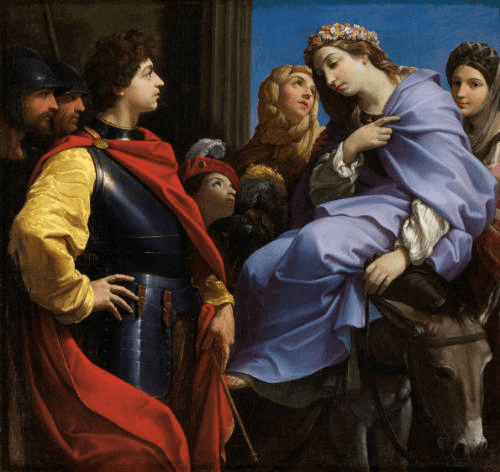
Artist Guido Reni (Italian, 1575-1642)
And I was also thinking as I went from the OT to the NT passage in the daily reading, I am so glad that names have gotten more ‘normal’! In Acts we read names such as Matthew, Levi, Peter, Paul… Lol, I guess I don’t only ask questions of the text, but I obviously have opinions too!
In the OT we read a lot about the Kohathites. I’m not clear on who they were. So, who were they? Easton’s Bible Dictionary answered that one for me pretty quickly-
KORAHITES—that portion of the Kohathites that descended from Korah. (1.) They were an important branch of the singers of the Kohathite division (2 Chr. 20:19). There are eleven psalms (42–49; 84; 85; 87; 88) dedicated to the sons of Korah.
(2.) Some of the sons of Korah also were “porters” of the temple (1 Chr. 9:17–19); one of them was over “things that were made in the pans” (31), i.e., the baking in pans for the meat-offering (Lev. 2:5).
Easton, M. G. (1893). In Illustrated Bible Dictionary and Treasury of Biblical History, Biography, Geography, Doctrine, and Literature (p. 412).
In 1 Chronicles 11:23 we read this interesting factoid, which the Holy Spirit wanted included:
And he killed an Egyptian, a man of great stature five cubits tall. Now in the Egyptian’s hand was a spear like a weaver’s beam, but he went down to him with a club and snatched the spear from the Egyptian’s hand and killed him with his own spear.
Soooo, how tall is “5 cubits”? Using the measurements conversion table in my Bible, this guy was 7 1/2 to 8 feet tall! Reminds me of Goliath.
Soooo… how big is a ‘weaver’s beam’? Apparently, a weaver’s beam was the heavy wooden cylinder on a loom that held the warp threads. This link explains with photos.
The same is mentioned when describing Goliath, too. The Old Testament folks would have been quite familiar with looms and weaving, since they had to make all their own clothes. The estimates for the size of the spear is 5′ tall and 2 1/2 inches around. Proportionally, an 8 foot guy would need a spear of that size and length.
Uriah…Sorting out the names in the Old Testament is hard. Reading along, I ask, “Who is Uriah? Is this Uriah the same Uriah I read about in the other chapter? Herbert Lockyer answers. His book All the Men of the Bible shows there were 6 different men named Uriah. OK, no wonder I got confused. The Lockyer book is available at Amazon in hard copy and Kindle format.
Asking questions of the text is a good approach. I ask myself things for physical reasons, like how far, how long, how big, who are they? But also for spiritual reasons, for illumination, understanding, and application.
HB Charles wrote this essay 5 Questions to Ask of the Text.
It is time to study the word of God. You pray for illumination (Psalm 119:18). You select a passage of scripture to study. You then… This is where many people get stumped. Every time. They come to the text with good intentions. But they do not have a clear process for properly understanding the text. To get the right answers in your study of scripture, you must ask the right questions. This is called inductive Bible study. Here are five fundamental questions to ask as you study a passage of scripture.
Mr. Charles continues with explaining the 5 questions in short order. It isn’t technical. It is worth reading.
I admit the genealogies are a challenge for me to read, they are a bit boring. And the names are hard to pronounce in my mind as I read. But all scripture is profitable, for sure. How do you approach reading some of the less well known parts of the Old Testament?