Where was The Bank of Asia?
By Elizabeth Prata
Introduction
Ephesus was a huge city and attracted thousands of people. The city was a crossroads. One reason was because the temple of Artemis was there and worshipers came from all over in their pilgrimages to pay homage to this (fictional) goddess.
Artemis was the ancient Greek goddess of the hunt, the wilderness, wild animals, and young girls. She was also heavily associated with childbirth and fertility, such as in regional cults like the one in Ephesus.
Ephesus’ Temple of Artemis, AKA The Artemision, was one of the 7 wonders of the ancient world. Four times bigger than the Parthenon in Greece, it served not only as a worship center, but housing for refugees, and something else! But first, about Ephesus.
What was Ephesus like?
In the 1st and 2nd centuries AD, the city of Ephesus was a massive, cosmopolitan metropolis. Its estimated population of 200,000 to 250,000 people made it the 4th biggest city in the Roman Empire. “Ephesus commanded the west end of one great trade route into Asia”, says Encyclopedia Britannica. Ephesus was wealthy beyond imagination. The wealth generated by this vibrant and busy trading port funded the city’s luxurious marble streets, street lights, and grand monuments like the Temple of Artemis. Ephesus also boasted the Library of Celsus and held over 12,000 scrolls. It also was one of the most impressive buildings in the Roman Empire.
What was the Temple of Artemis like?
The Temple was one of the 7 Wonders of the Ancient World. Why? Though the temple was destroyed and rebuilt three times, the final and most famous version of the temple measured about 450 feet long by 225 feet wide, supported by over 127 marble columns, standing 60 feet tall. The temple was lauded for the incredible art and statuary inside. Open to the sky in the middle, it was said to be the largest structure in the ancient world.
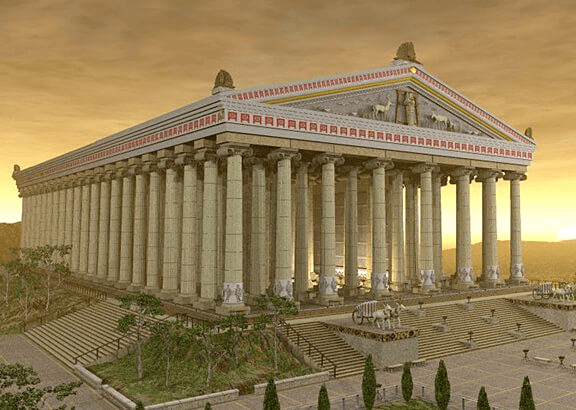
Antipater of Sidon described the temple as the grandest of all the 7 Wonders: “I have set eyes on the wall of lofty Babylon on which is a road for chariots, and the statue of Zeus by the Alpheus, and the hanging gardens, and the colossus of the Sun, and the huge labour of the high pyramids, and the vast tomb of Mausolus; but when I saw the house of Artemis that mounted to the clouds, those other marvels lost their brilliancy, and I said, Lo, apart from Olympus, the Sun never looked on aught (anything) so grand”. (Antipater, Greek Anthology IX.58).
The Temple was always swirling with priests and priestesses, musicians, pilgrims, acrobats, refugees, and bankers.
Wait, what?
Yes, the Artemision was also a bank.
The Bank of Asia
The city of Ephesus was incredibly rich. You might have heard the term ‘Rich as Croesus’. He was an actual king of the region that had conquered Ephesus in 561 BC. He was incredibly rich indeed. He funded the temple construction.
With the throbbing mix of merchants constantly coming and going, they needed a place to store their valuables. Jewelry, art, and money was stored there. King Croesus actually was the first in the region to mint coins. He produced the first standardized pure gold and pure silver coins, called the Croeseid.
The Temple was known as the Bank of Asia. Depositors even earned interest. Loans were regularly given out. It was considered sacrilegious to steal from a temple, which was populated by priests and soldiers 24/7 anyway, so the location was considered highly secure. Depositors even earned interest.
Ephesus was proud, highly proud of its stature as a thriving and important metropolis. Rivals were Smyrna and Pergamum, you remember those churches also received a letter in the book of Revelation. In Australia’s Macquarie University they wrote a book on the coinage of Ephesus. We read the following in chapter 6:
On the other hand, Ephesus had its rivals within the province: great cities like Pergamon and Smyrna, both of which became neokoros before Ephesus did (q.v.). Each of the three cities claimed to be metropolis of Asia, and all kept a jealous eye on the others’ honors and titles. Inscriptions found at Ephesus refer to an incident where Ephesus wrote to Antoninus Pius to complain that Smyrna and Pergamon were not giving Ephesus its proper honorific titles. Antoninus replied by trying to soothe ruffled feelings, but required that Ephesus receive the titles he had approved for it, and asked the cities to give each other their proper titles. Ephesus obviously saw this as a victory, as it engraved the Emperor’s letter on stone at least twice, and issued coin.
Enter Demetrius
You might remember the Bible’s description of the Riot at Ephesus in Acts 19:23-41. Paul had been preaching, and his efforts, carried along by the Holy Spirit, caused many conversions to Christianity. The city of Ephesus, with its pagan temple looming over the lives of its denizens, was the epicenter for worship- and as we have learned- of commerce too. And now comes along this upstart religion, and worse, it was making an impact.
The impact was not only counted in souls, but the commercial impact was large. Demetrius was a silversmith, thought to probably be head of the guild, who opposed ‘The Way’. The city earned massive amounts of money by its craftsmen making gold and silver idols and all other items that went with the Temple activity.
Demetrius had had enough. He gathered the craftsmen and said as recorded in verse 25-26, “Men, you know that our prosperity depends upon this business. You see and hear that not only in Ephesus, but in almost all of Asia this Paul has persuaded and turned away a considerable number of people, saying that gods made by hands are not gods at all. Not only is there danger that this trade of ours will fall into disrepute, but also that the temple of the great goddess Artemis will be regarded as worthless, and that she whom all of Asia and the world worship will even be dethroned from her magnificence.””
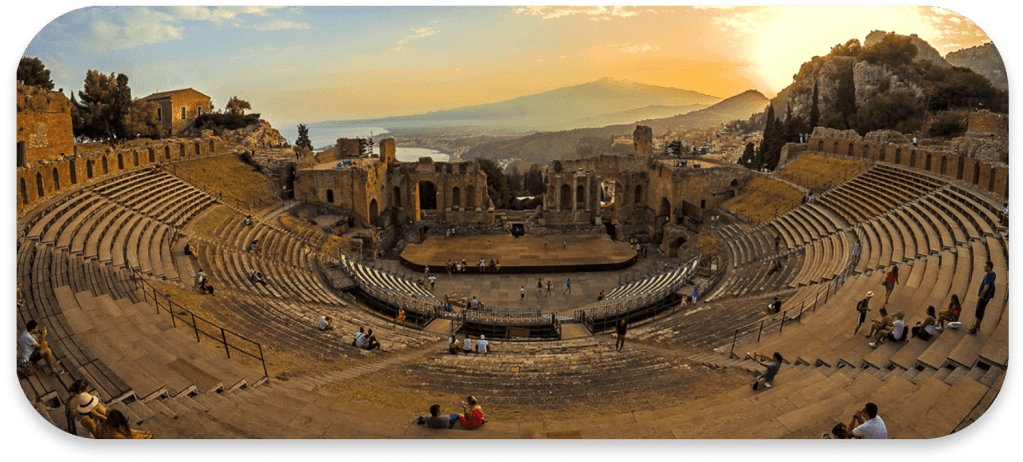
He was crafty. He mentioned the prosperity but then turned his speech to make it be about the goddess who needed her proper due, and that her worship was under attack. The theater at Ephesus was suddenly filled. It was said to hold up to 25,000 people.
Now perhaps knowing that the Temple was also a commercial center and regional bank, we can re-order our thinking about the motivations of Demetrius’s speech. We can say ‘Ah! NOW I see his concern.’ If the pagan idol commerce failed, bank loans would fail, the bank would be seen as insecure, and commerce would be impacted across a wide swathe of Asia.
It wasn’t just his personal checking account that Demetrius was worried about. It was regional economy, status, and his industry being the underpinnings of it all.
Isn’t it interesting! I never would have known this except for the curiosity I have about buildings and architecture. I’ve discovered interesting facts about-
about apartment buildings in the ancient world (the one Eutychus fell out of and died and was resurrected),
and now the Temple of Artemis!