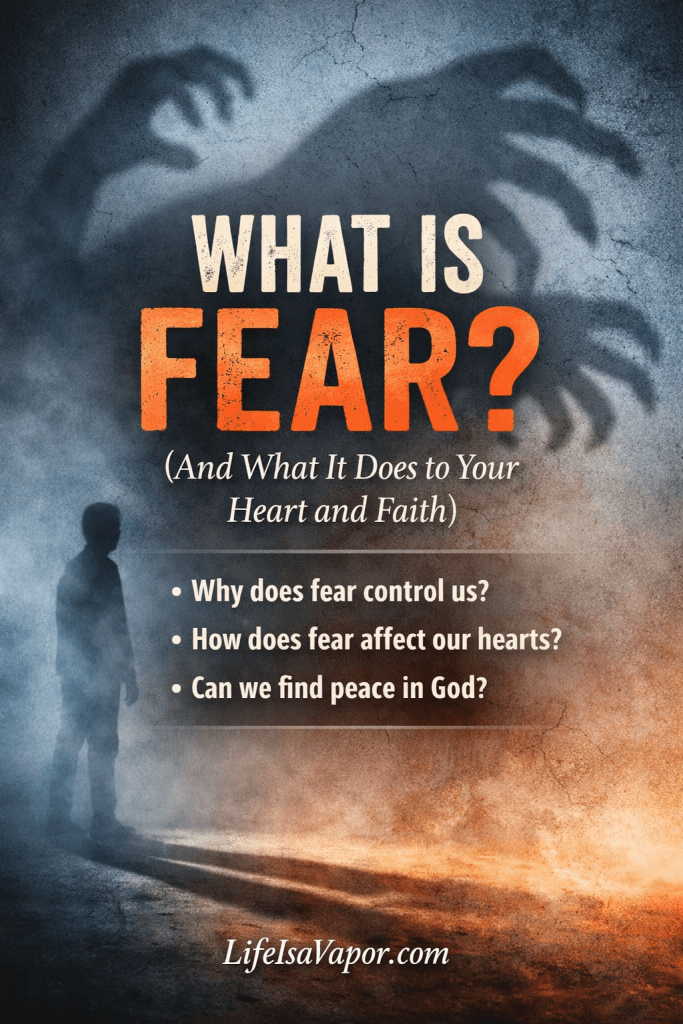
What Is Fear? (And What It Does to Your Heart and Faith)
Fear is something every person experiences—but few truly understand. What is fear, really? Why does it feel so powerful, and what does it do to our hearts, minds, and faith?
If you’ve ever felt gripped by anxiety, weighed down by worry, or paralyzed by uncertainty, you’re not alone. Fear is one of the most common human experiences. Yet Scripture shows us that fear is not something we were meant to live in.
In this post, we’ll explore what fear is, why it affects us so deeply, and what it does to us—spiritually, emotionally, and mentally.
What Are the Most Common Fears People Face Today?
I recently asked my Facebook friends what kinds of fears are commonly faced today, in preparation for this article. Here are some of the things they said:
- Dying
- Terminal illness
- Failure
- Financial concerns
- Not being good enough
- Being alone
- Rejection
- Public speaking
- Phobias (ex: claustrophobia)
- An uncertain future
- Other people’s opinions
- Commitment
- Homelessness/starvation
- Going to Hell
- Losing a child
- Being misunderstood
- The unknown
- Uncertainty
- Being disappointed
- Being forgotten
- Pain
- The aging process
These are some of the most common fears people experience in everyday life.
Perhaps you can identify with something on that list. Maybe one of these fears feels especially close to home. It might even be pressing in on you as you read this.
But don’t stop reading.
Related: What is the Christian’s Delight?
What Is Fear? (A Biblical and Practical Definition)
So what is fear?
Fear is often defined as an unpleasant emotion caused by the belief that someone or something is dangerous, likely to cause pain, or a threat. As a verb, it means to be afraid of something perceived as harmful or dangerous.
Other definitions describe fear as:
- “Anxious concern”
- “To expect with alarm”
There are also many related words that reflect what fear feels like in daily life:
- Anxiety
- Apprehension
- Worry
- Nervousness
- Stress
- Uneasiness
- Panic
- Alarm
- Terror
We have all felt fear.
Sometimes it comes suddenly—a moment of real danger, when your heart races and your body reacts instantly. But more often, fear is quieter. It lingers. It settles in.
For many people, fear becomes a constant companion. It dwells within us as if it has made its home in our hearts. And over time, it can begin to feel… normal.
Like a prisoner who has grown accustomed to their cage, some people live with fear for so long that they can’t imagine life without it.
Related: The Heart That Heals: A Review

What Fear Does to the Heart and Soul
Fear is not just an emotion—it has consequences. Real, deep, lasting consequences.
Theologian Dietrich Bonhoeffer once described fear this way:
“It crouches in people’s hearts. It hollows out their insides, until their resistance and strength are spent… Fear secretly gnaws and eats away at all the ties that bind a person to God and to others…”
That’s a powerful picture—and an accurate one.
Fear doesn’t just visit. It consumes.
Fear weakens your connection to God
One of the most dangerous effects of fear is how it affects your relationship with God.
Fear causes us to:
- Doubt His goodness
- Question His control
- Forget His promises
Instead of looking upward in trust, we turn inward in self-protection.
And when we finally reach out for help—when we try to cling to truth—it can feel like those connections have already been weakened.
Related: When Anger Takes Over
Fear isolates you from others
Fear also impacts our relationships.
It can make us:
- Withdraw from people
- Avoid vulnerability
- Assume the worst about others
- Fear rejection or misunderstanding
Instead of drawing near to others, we pull away. And over time, fear can leave us feeling alone—even when we’re not.
Related: Fear: What You Can Do About It (Part 2)
Fear affects your thoughts and decisions
Fear doesn’t just sit quietly in the background—it actively shapes the way you think.
It can:
- Distort reality
- Magnify problems
- Minimize hope
- Paralyze decision-making
When fear takes over, even simple decisions can feel overwhelming.
Fear impacts your physical and emotional health
Struggling with fear and anxiety can also affect your body.
Many people experience:
- Chronic stress
- Fatigue
- Restlessness
- Trouble sleeping
- Physical tension
For some, it becomes so overwhelming that they need medical help just to manage the symptoms.
Fear is not just “in your head.” It affects your whole being.
Why Does Fear Control Us So Powerfully?
If fear is so damaging, why does it have such a strong hold on us?
The answer is complex—but part of it is what we see around us every day.
We live in a world filled with uncertainty.
We look around and see:
- Economic instability
- Social division
- Political unrest
Everything can feel like it’s spinning out of control, with no clear solution in sight. It’s no wonder so many people feel anxious and afraid.
Fear grows in uncertainty
Fear thrives in the unknown.
When we don’t know what will happen next, our minds try to fill in the gaps—and often, we imagine the worst.
We begin to fear:
- What might happen
- What could go wrong
- What we might lose
And the more we dwell on those possibilities, the stronger fear becomes.
Fear feeds on lies
Fear is also fueled by the messages we believe.
Sometimes those messages come from:
- Other people
- Society
- Our past experiences
And sometimes, they come from something deeper and darker—the enemy himself.
We begin to believe lies like:
- “You’re not good enough”
- “You’re going to lose everything”
- “You’re alone”
- “There’s no hope”
And as those lies take root, fear tightens its grip.
Fear keeps us looking down
When fear takes hold, it changes not only how we think—but how we carry ourselves.
Our eyes become downcast.
Our shoulders slump.
Our hearts grow heavy.
We live as though we are constantly on the verge of losing something:
- A relationship
- Our health
- Our security
- Our future
And all the while, fear keeps us focused on what we might lose—rather than on the God who holds everything together.
Can Fear Be Overcome? (Finding Peace in God)
Understanding fear is important—but it’s not the end of the story.
The good news is that fear does have an enemy.
That enemy is peace.
Not the kind of peace the world offers—temporary, fragile, and dependent on circumstances—but a deep, steady peace that comes from God Himself.
God’s peace replaces fear
Jesus said:
“Peace I leave with you; my peace I give you. I do not give to you as the world gives. Do not let your hearts be troubled and do not be afraid.” (John 14:27)
This kind of peace doesn’t ignore fear—it overcomes it.
It anchors you in the middle of uncertainty.
It steadies your heart when everything feels unstable.
It reminds you that you are not alone.
God’s peace changes how you live
As one writer beautifully put it, God’s peace doesn’t just calm us—it transforms us.
It gives us:
- Freedom to rest
- Strength to endure
- Courage to move forward
God quiets our souls—but He also sets them on fire.
Instead of shrinking back in fear, we begin to live boldly, even in difficult circumstances.
Fear doesn’t leave easily—but it doesn’t win
Let’s be honest—fear doesn’t go away quietly.
It clings.
It resists.
It tries to hold on.
But no matter how strong it feels, fear is not stronger than God.
When you begin to turn to Him, to trust Him, and to believe His promises, fear begins to lose its power.
Where to begin
If you’re struggling with fear, start here:
“I sought the LORD, and he answered me; he delivered me from all my fears.” (Psalm 34:4)
And hold on to this promise:
“Do not fear, for I am with you… I will strengthen you and help you; I will uphold you with my righteous right hand.” (Isaiah 41:10, 13)
These are not empty words. They are truth.
And they are a foundation you can stand on.
What Comes Next?
Understanding fear is the first step—but it’s not the end of the journey.
God doesn’t leave us trapped in fear. He shows us how to walk out of it.
👉 Read next: How to Overcome Fear (A Biblical Guide)
In the next post, we’ll take a deeper look at practical, biblical ways to break free from fear and walk in the peace God promises.
Frequently Asked Questions About Fear
What causes fear in the first place?
Fear is often triggered by perceived danger, uncertainty, or loss of control. It can come from real experiences, imagined outcomes, past trauma, or deeply held beliefs about ourselves and the world. Spiritually, fear can also grow when we lose sight of God’s presence and promises.
Why do I feel afraid even when nothing is wrong?
This is more common than you might think. Fear doesn’t always come from immediate danger—it often comes from anticipation. Your mind may be trying to prepare for “what if” scenarios, even when everything seems fine on the surface.
What’s the difference between fear and anxiety?
Fear is usually a response to a specific, immediate threat, while anxiety tends to be more ongoing and tied to future concerns or uncertainties. The two are closely related and often overlap, especially in daily life.
Why does fear make it hard to trust God?
Fear shifts our focus from who God is to what might happen. When we fixate on uncertainty or worst-case scenarios, it becomes harder to rest in God’s control, even if we know the truth intellectually.
Does everyone struggle with fear?
Yes. Fear is a universal human experience. Even strong believers throughout Scripture wrestled with fear at times. The difference isn’t whether fear shows up—but how we respond when it does.
When should I seek help for fear or anxiety?
If fear is interfering with your daily life—your sleep, relationships, decision-making, or health—it may be time to seek help. Talking to a trusted friend, pastor, or professional can be an important step toward healing.
If this article was helpful, please share it!

♥ Are you a Christian Single? Here’s a great – and safe – way to meet people! Check out Christian Cafe! You won’t regret it! ♥

Bibles, books, music, gifts and more! Click here to browse!