The Plight of Rizpah: A Mother’s Vigil of Love and Devotion
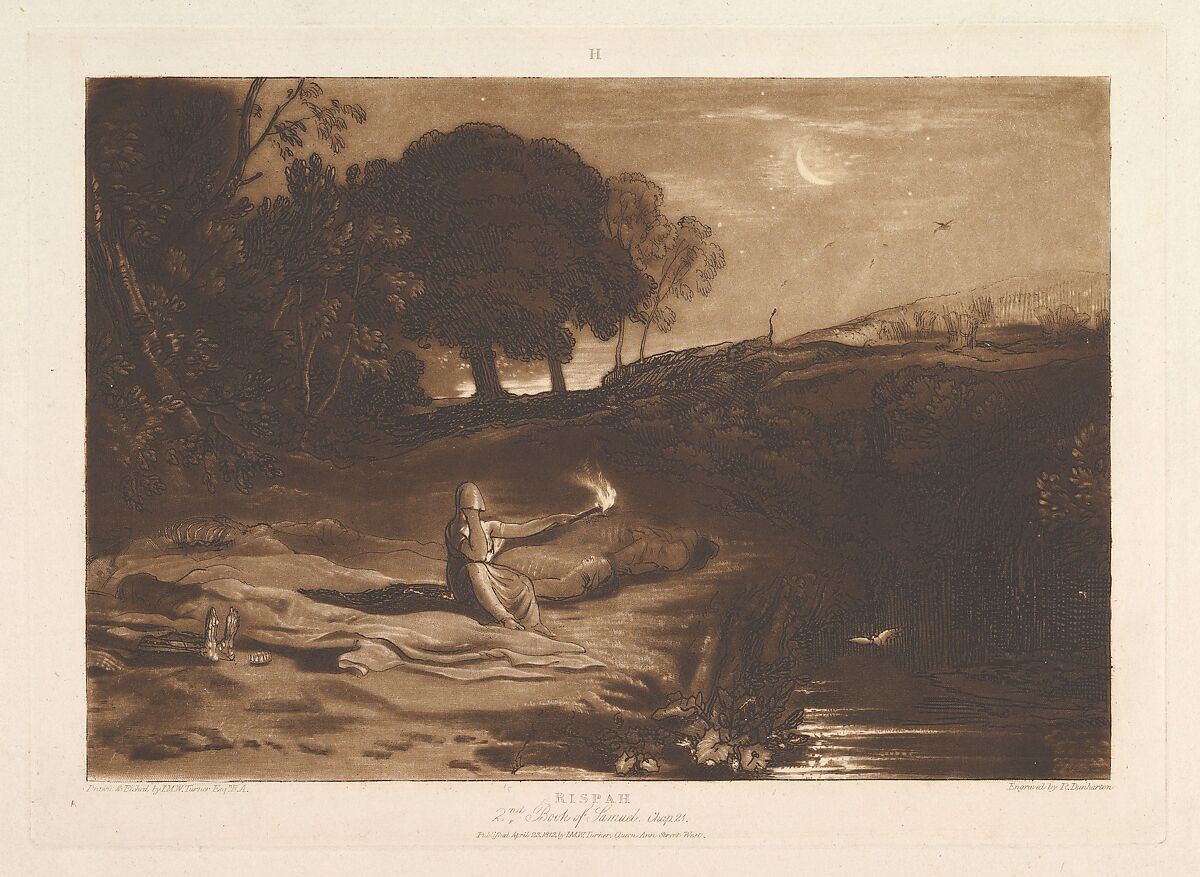
Rizpha’s Vigil
by Joseph Mallord William Turner (1812)
The story of Rizpah, daughter of Aiah, stands as one of the most haunting and powerful narratives of maternal devotion in biblical literature. Found in 2 Samuel 21:1-14, her account reveals the profound depths of a mother’s love in the face of unspeakable tragedy, political machinations, and divine judgment. As a concubine of King Saul who witnessed the execution of her two sons for crimes they did not commit, Rizpah’s response transformed personal grief into an act of extraordinary courage that would ultimately move a king and restore honor to an entire royal house. Her story speaks powerfully to mothers across generations who have endured the loss of children to violence, injustice, and the cruel machinations of power.
Since most people have never read Rizpah’s story, I will quote it so that we can see the horrors this mother experienced:
The Story of Rizpah – 2 Samuel 21:1–14
1 Now there was a famine in the days of David for three years, year after year; and David inquired of the LORD. The LORD said, “There is bloodguilt on Saul and on his house, because he put the Gibeonites to death.”
2 So the king called the Gibeonites and spoke to them. (Now the Gibeonites were not of the people of Israel, but of the remnant of the Amorites; although the people of Israel had sworn to spare them, Saul had tried to wipe them out in his zeal for the people of Israel and Judah.)
3 David said to the Gibeonites, “What shall I do for you? How shall I make expiation, that you may bless the heritage of the LORD?”
4 The Gibeonites said to him, “It is not a matter of silver or gold between us and Saul or his house; neither is it for us to put anyone to death in Israel.” He said, “What do you say that I should do for you?”
5 They said to the king, “The man who consumed us and planned to destroy us, so that we should have no place in all the territory of Israel–
6 let seven of his sons be handed over to us, and we will impale them before the LORD at Gibeon on the mountain of the LORD.” The king said, “I will hand them over.”
8 The king took the two sons of Rizpah daughter of Aiah, whom she bore to Saul, Armoni and Mephibosheth; and the five sons of Merab daughter of Saul, whom she bore to Adriel son of Barzillai the Meholathite;
9 he gave them into the hands of the Gibeonites, and they impaled them on the mountain before the LORD. The seven of them perished together. They were put to death in the first days of harvest, at the beginning of barley harvest.
10 Then Rizpah the daughter of Aiah took sackcloth, and spread it on a rock for herself, from the beginning of harvest until rain fell on them from the heavens; she did not allow the birds of the air to come on the bodies by day, or the wild animals by night.
11 When David was told what Rizpah daughter of Aiah, the concubine of Saul, had done,
12 David went and took the bones of Saul and the bones of his son Jonathan from the people of Jabesh-gilead, who had stolen them from the public square of Beth-shan, where the Philistines had hung them up, on the day the Philistines killed Saul on Gilboa.
13 He brought up from there the bones of Saul and the bones of his son Jonathan; and they gathered the bones of those who had been impaled.
14 They buried the bones of Saul and of his son Jonathan in the land of Benjamin in Zela, in the tomb of his father Kish; they did all that the king commanded. After that, God heeded supplications for the land.
The Context of Calamity
Rizpah was the daughter of Aiah and a concubine, or second wife, to King Saul, Israel’s first monarch. In the patriarchal society of ancient Israel, concubines occupied a complex social position—they were considered legitimate wives with some rights, including the ability to bear children for their master, yet they remained subordinate to primary wives and held limited social status. This marginalized position would prove significant as political forces beyond Rizpah’s control converged to destroy her family.
The tragedy that befell Rizpah stemmed from events that predated her sons’ birth. During King Saul’s reign, he had violated a sacred covenant made by Joshua, who had promised the Gibeonites—a remnant of the Canaanites—protection from destruction. In his zeal for the people of Israel and Judah, Saul attempted to annihilate the Gibeonites, breaking this divinely witnessed oath. According to 2 Samuel 21:1, when a devastating three-year famine struck Israel during David’s reign, the new king inquired of the Lord about its cause. God revealed that the famine resulted from bloodguilt on Saul’s house for the massacre of the Gibeonites.
Biblical droughts signaled divine discontent, as precipitation was understood to be within God’s providence. As an agricultural society dependent on rainfall for survival, Israel faced existential crisis. David, seeking to atone for Saul’s offense and end the drought, approached the Gibeonites to ask how he might make expiation. Their response was chilling: they demanded seven of Saul’s male descendants to be handed over and impaled before the Lord at Gibeon on the mountain. The text does not indicate that God explicitly commanded this particular form of atonement, yet David agreed to their terms, surrendering the lives of Saul’s grandsons and the two sons of Rizpah—Armoni and Mephibosheth—to satisfy the debt of bloodguilt.
A Mother’s Unimaginable Horror
The moment when King David’s messengers arrived to take Rizpah’s sons marked the beginning of her descent into unimaginable horror. It is difficult to process that this mother would have allowed the last thought her sons had of her to be that of a mother who would not at least attempt to fight for their lives. It is possible that the women were likely pleading for the lives of their sons, asking neighbors, family, and anyone around for help, and even cursing David and the soldiers as their sons were dragged away for the last time.
As a mother, Rizpah would have been desperately seeking an alternative solution to this matter that did not end with the brutal, violent, and humiliating murder of her innocent sons. As a former concubine to the king, she surely knew who wielded power and likely appealed to them diligently but with dignity.
The method of execution was impalement—a gruesome, torturous death that left the victims exposed on the mountain before the Lord. The seven men, including Rizpah’s two sons and five grandsons of Saul through his daughter Merab, were killed at the beginning of the barley harvest. Their bodies were left hanging, a common practice in antiquity meant to further humiliate the deceased and serve as a warning to others of the might of the executioner. For Rizpah, the horror was multidimensional. Not only had she witnessed the seizure and execution of her sons for crimes committed by their father, but she was now forced to witness the dishonor and desecration of their bodies.
The psychological and emotional devastation of such an experience defies comprehension. To watch one’s children—the very embodiment of a mother’s love and hopes—subjected to such brutal violence and then denied even the basic dignity of burial represents a form of torture that extends beyond the physical into the spiritual and emotional realms. The impaled bodies would have been visible from a distance, a constant reminder to Rizpah and the community of the price paid for royal transgression. The stench of decomposing flesh, the sight of her sons’ features becoming unrecognizable, the knowledge that wild animals and birds of prey were circling, waiting to feast on the remains—these horrors would have been Rizpah’s daily reality for months to come.
The Depths of Maternal Love
In the face of this overwhelming grief and horror, Rizpah did something remarkable. Rather than retreating into private mourning or accepting the public shame and dishonor inflicted upon her family, she took action. According to 2 Samuel 21:10, “Rizpah the daughter of Aiah took sackcloth, and spread it on a rock for herself, from the beginning of harvest until rain fell on them from the heavens; she did not allow the birds of the air to come on the bodies by day, or the wild animals by night.”
This simple statement conceals the extraordinary nature of Rizpah’s vigil. She established herself on a rock with sackcloth—a coarse covering usually made of goat wool used in mourning rituals—combining ancient lamentation practices with an act of fierce maternal protection. Her vigil lasted approximately six months, from Nissan (March/April) to Tishrei (September/October), spanning the entire period from the beginning to the end of the barley harvest. Six months of unceasing watchfulness, of fighting off predators, of enduring the elements, of witnessing the slow decomposition of her beloved sons’ bodies—this was the price Rizpah was willing to pay to ensure their remains received some measure of dignity.
The love demonstrated in Rizpah’s actions reveals depths that few can fathom. Though Rizpah could not protect her sons in life from their horrible fate, she alone did the only thing she could do in this situation: she protected them in death. This protection was not merely symbolic. Rizpah physically fought off the birds of the air by day and the wild animals by night, presumably armed with whatever implements she could find—perhaps a stick or staff—and her own fierce determination. The fact that she received no harm from these predatory animals during her lengthy vigil speaks to what can only be described as divine protection, enabling her to maintain her watch.
The depth, length, width, and height of Rizpah’s love manifested in her willingness to subject herself to conditions that would have broken most people. In antiquity, she would have been regarded as ritually unclean for being with the dead for such an extended period. She would have been separated from community, from comfort, from the ordinary rhythms of life. The physical toll alone—exposure to the elements, lack of proper sleep, the constant vigilance required to ward off predators—would have been extraordinary. Yet she persisted, demonstrating a quiet strength that testified to her commitment.
The Vigil: Commitment Beyond Comprehension
The duration of Rizpah’s vigil—six months—demands special attention, for it reveals the extent of her commitment and the depths of her maternal devotion. From the beginning of the barley harvest in spring until the autumn rains finally fell, Rizpah maintained her post on the mountain. Day after day, night after night, she fought an unceasing battle against nature itself to preserve the dignity of the dead.
The practical challenges of such an undertaking were immense. How does one maintain vigilance for six months without succumbing to exhaustion, illness, or despair? Some scholars have questioned whether Rizpah could have accomplished this feat alone. However, the biblical text mentions no helper, focusing solely on Rizpah’s solitary vigil. Whether she received assistance or not, the commitment required was extraordinary.
The sackcloth she spread upon the rock served multiple symbolic purposes. It marked her as one in mourning, following the ancient ritual of spreading sackcloth on the ground and prostrating oneself as part of the grieving process. But it may also have represented an act of repentance on behalf of the land, similar to how the people of Nineveh donned sackcloth when Jonah warned them of God’s coming judgment. In this interpretation, Rizpah was not merely protecting her sons’ bodies but standing in the gap, interceding for Israel, offering her suffering as a form of atonement that complemented the blood sacrifice of the seven men.
Throughout these months, Rizpah would have had much time alone with God. One can imagine her prayers, her questions, her wrestlings with divine justice. How could innocent sons be punished for their father’s crimes, especially when Deuteronomy explicitly stated that children should not be put to death for their parents’ sins? Yet Rizpah persisted in faith, trusting that God would hear her cries and honor her sons with proper burial. Her endurance speaks to a supernatural strength that could only have come from divine sustenance, fulfilling God’s promise never to leave or forsake those who call upon Him.
The Impact of Rizpah’s Sacrifice
Rizpah’s vigil did not go unnoticed. As the months passed and word of her dedication spread, her actions became the subject of conversation throughout Israel. When David finally heard what Rizpah had done, he was moved to action. The text states in 2 Samuel 21:11–14 that David went and retrieved the bones of Saul and his son Jonathan from the people of Jabesh-gilead, who had stolen them from the public square of Beth-shan where the Philistines had displayed them. He then gathered the bones of the seven impaled men and commanded that all be buried together in the land of Benjamin in Zela, in the tomb of Saul’s father Kish. Only after this proper burial did God heed supplications for the land, and the rains came.
Rizpah’s actions brought about more than just the burial of her sons. Her dedication inspired David to complete what should have been done long before: retrieving and properly burying Saul and Jonathan, whose bones had remained in a foreign land since their deaths. If the exposure of seven young men on a mountain was pitiful, how much more shameful was it that Israel’s first king and his heroic son remained unburied? Rizpah’s vigil thus became a catalyst for restoring honor to the entire house of Saul and perhaps even achieving a form of reconciliation between David and his predecessor.
Legacy and Lessons
The story of Rizpah resonates across cultures and centuries because it speaks to universal experiences of loss, powerlessness, and the fierce love of mothers for their children. In contemporary contexts where violence claims the lives of innocent youth—whether through war, crime, or injustice—Rizpah’s story offers both comfort and challenge. She models how to respond to tragedy with dignity, how to protest injustice through persistent action, and how to maintain faith even when circumstances seem unbearably dark.
NOTE: This post was the Bible study lesson I presented to the members of Growing in Grace, the senior study group of The Compass Church, in Naperville, Illinois, on January 11, 2026.
Claude Mariottini
Emeritus Professor of Old Testament
Northern Baptist Seminary
If you enjoyed reading this post, you will enjoy reading my books.
VISIT MY AMAZON AUTHOR’S PAGE
BUY MY BOOKS ON AMAZON (Click here).
NOTE: Did you like this post? Do you think other people would like to read this post? Be sure to share this post on Facebook and share a link on X so that others may enjoy reading it too!
If you are looking for other series of studies on the Old Testament, visit the Archive section and you will find many studies that deal with a variety of Old Testament topics.