The Armor of God: A Complete Guide to Ephesians 6
Paul wrote about armor while chained to a soldier.
That detail is easy to miss, but it changes how you read the passage. When the apostle reached for the most famous picture of the Christian life in the whole New Testament — the armor of God — he was almost certainly looking at a real Roman guard a few feet away, close enough to touch the man's belt and breastplate. He was a prisoner. The soldier was his keeper. And out of that strange arrangement came a metaphor the church has never stopped using.
You have probably heard the phrase. Maybe you grew up singing about it in Sunday school, or you have a coffee mug with the list of pieces printed on it. But the armor of God is not a slogan and it is not a children's craft. It is Paul's clear-eyed answer to a question every believer eventually asks: why is following Jesus so much like a fight?
This is a walk through the whole passage — what the armor is, why Paul describes it the way he does, and how it actually works on an ordinary Tuesday when you are tired and tempted and not feeling especially spiritual.
What is the armor of God?
The armor of God is a word picture Paul uses in Ephesians 6:10-18 to describe the spiritual resources God gives every believer for standing firm against evil. It is not literal metal. It is a set of gifts — truth, righteousness, peace, faith, salvation, and the word of God — each one mapped onto a piece of a soldier's equipment so you can picture how they fit together and what they are for.
If you are new to all of this, it helps to start with the basics before the details — here is what the armor of God actually is, explained from the ground up.
Paul opens the passage with the command that frames everything after it:
"Finally, be strong in the Lord and in his mighty power. Put on the full armor of God, so that you can take your stand against the devil's schemes." (Ephesians 6:10-11)
Notice two things right away. The strength is borrowed — "in the Lord," not in yourself. And the armor is something you put on. It is provided, but it is not automatic. A soldier with his breastplate hanging on a hook is no safer than a soldier with none.
The battle Paul is actually describing
Before he lists the gear, Paul names the enemy — and it is not who you would expect.
"For our struggle is not against flesh and blood, but against the rulers, against the authorities, against the powers of this dark world and against the spiritual forces of evil in the heavenly realms." (Ephesians 6:12)
This is the part people skip. We are quick to treat other people as the problem — the difficult coworker, the family member who wounds us, the stranger on the internet who infuriates us. Paul lifts our eyes higher. The real conflict runs underneath the visible one. The weapons that matter are not the ones you can hold, which is exactly why 2 Corinthians 10:4 says the believer's weapons "have divine power to demolish strongholds."
So the armor is defensive for a reason. It is built for a long stand, not a quick win.
The six pieces, one at a time
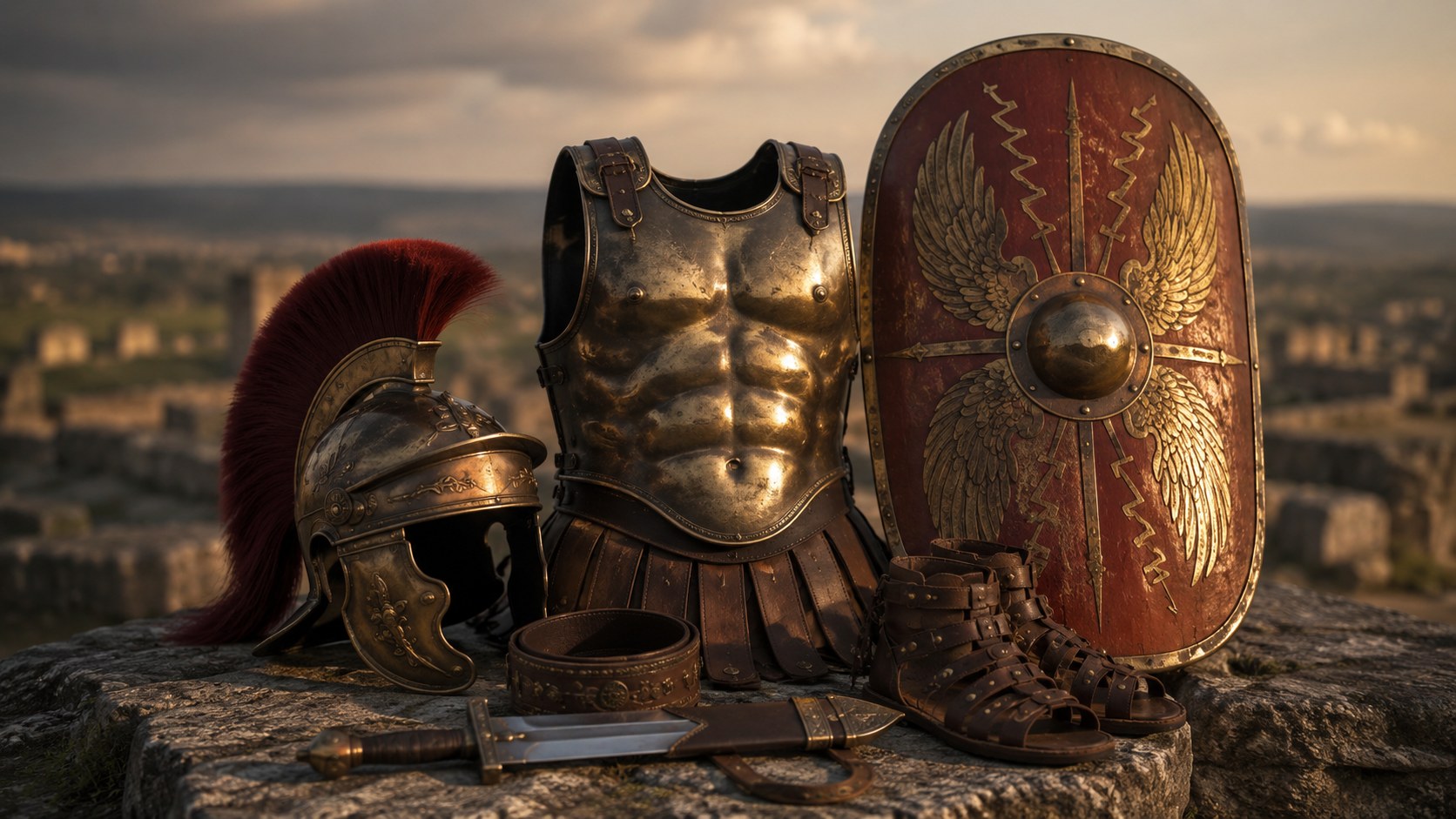
Paul takes the equipment of a first-century legionary and assigns each piece a meaning. He is not being random. The order and the imagery both carry weight.
The belt of truth
"Stand firm then, with the belt of truth buckled around your waist" (Ephesians 6:14). The soldier's belt held everything else in place — it was what he cinched first, the foundation the other pieces hung from. Truth works the same way. A life built on what is actually real, rather than on the flattering or fearful stories we tell ourselves, holds together under pressure. There is more to this small, load-bearing piece than it first appears; this is the belt of truth in full.
The breastplate of righteousness
The breastplate guarded the chest — the heart, the lungs, the organs you cannot live without. Righteousness covers the same vital ground in the soul. It is partly the gift of being made right with God, and partly the daily practice of doing what is right. Both protect you. You can read the whole picture of the breastplate of righteousness on its own, but the short version is this: guard your heart, because everything else flows from it (Proverbs 4:23).
Feet fitted with the gospel of peace
"And with your feet fitted with the readiness that comes from the gospel of peace" (Ephesians 6:15). Roman soldiers wore hobnailed sandals that gripped the ground so they would not slip mid-fight. The gospel does that for your footing. Knowing you are at peace with God keeps you steady when everything around you is trying to knock you down.
The shield of faith
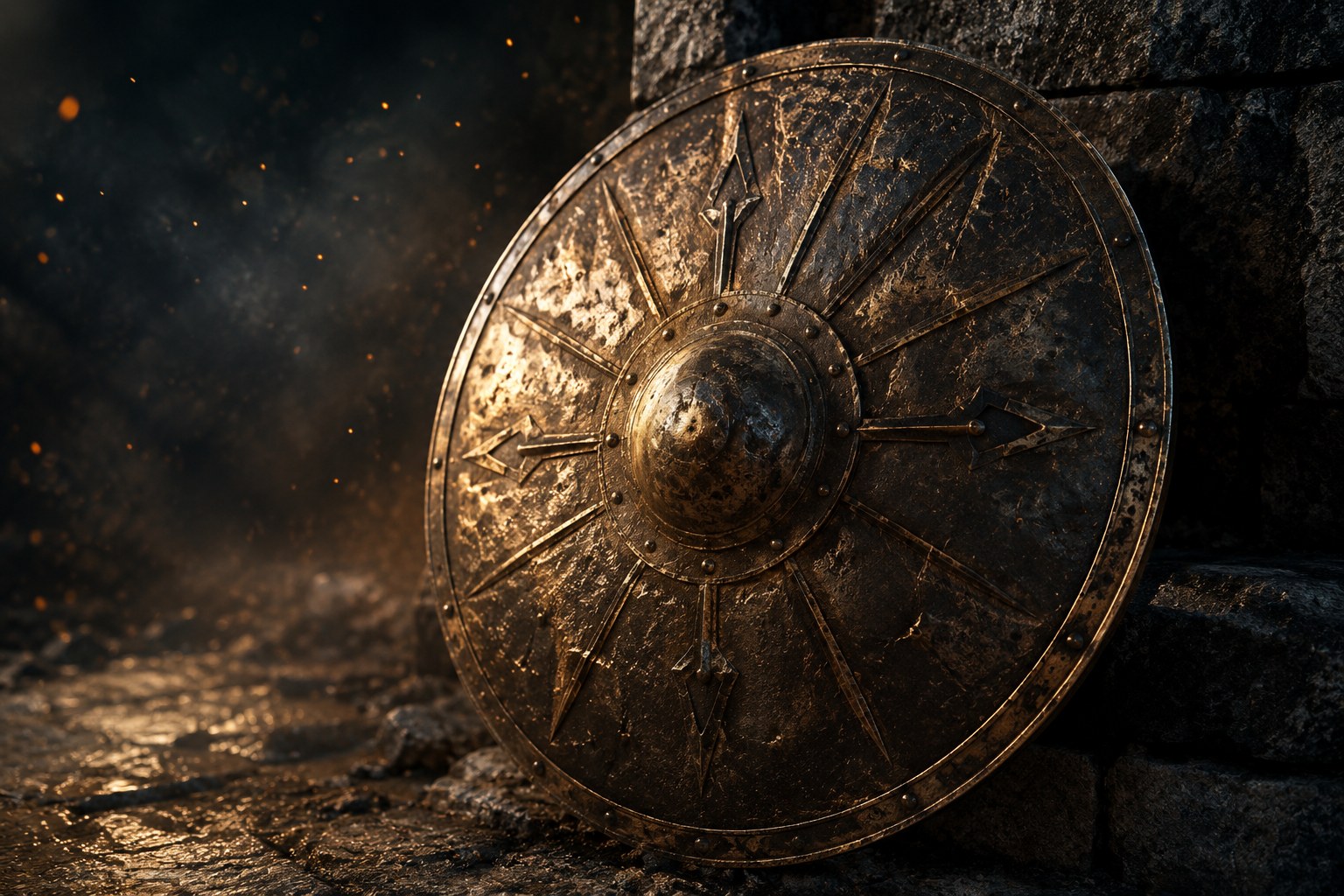
"Take up the shield of faith, with which you can extinguish all the flaming arrows of the evil one" (Ephesians 6:16). The Roman scutum was a full-body shield, soaked in water before battle so that incoming fire-arrows would hiss out on impact. Faith is that shield. The lies, the accusations, the sudden stabs of doubt — faith catches them before they catch you.
The helmet of salvation
The helmet protected the head — the mind, the place where so many battles are won or lost. Salvation guards your thinking. When you know whose you are and where you are going, despair has a much harder time getting a grip.
The sword of the Spirit
"Take... the sword of the Spirit, which is the word of God" (Ephesians 6:17). This is the only offensive piece in the whole kit, and it is worth understanding well. Scripture is not a quote to decorate your day; it is a weapon. Jesus himself used it that way in the wilderness. The full story of the sword of the Spirit is its own subject, because the one piece you can strike with is the one most of us pick up the least.
Where the picture really comes from
Here is a layer most readers miss. When Paul describes God's armor, he is borrowing language from the prophet Isaiah, who first pictured the armor on God himself:
"He put on righteousness as his breastplate, and the helmet of salvation on his head." (Isaiah 59:17)
That is the heart of it. The armor of God is not gear we manufacture. It is God's own armor, handed to his people. When you put on the breastplate of righteousness, you are wearing what God wears. The protection was never something we generated. It was always lent.
Putting it on, and the trap of doing it alone
Reading a list of six pieces can leave you with a checklist feeling, as though spiritual maturity were a matter of strapping on enough equipment. That is not the point. Each piece is a way of leaning on something God has already given. If you want the practical, piece-by-piece method, here is how to put it on piece by piece without turning it into a performance.
And notice where Paul lands. After the sword, he does not say "now go fight." He says pray: "And pray in the Spirit on all occasions with all kinds of prayers and requests" (Ephesians 6:18). Prayer is the air the armor breathes. One of the most concrete ways to start is to simply pray the armor over your day before your feet hit the floor. And when a season feels genuinely dangerous, that same instinct deepens into a prayer for protection, leaning on promises like Psalm 91.
What the armor of God teaches
1. The strength is borrowed, not summoned
Paul never tells you to be strong in yourself. "Be strong in the Lord." The whole point of armor is that it is not your skin. It is something stronger placed over your weakness. The day you stop trying to be your own protection is the day the armor starts working.
2. Most of the fight is staying upright
Four times in this passage Paul uses the word "stand." Not charge. Not conquer. Stand. Much of the Christian life is simply refusing to fall down — holding your ground on a hard day when quitting would be easier. That is not a small victory. That is the victory.
3. The enemy is real but already beaten
Paul takes the devil's schemes seriously, and so should you. But the armor is issued by a King who has already won. We do not fight for victory; we fight from it. Resisting evil is the posture of people who know how the story ends (James 4:7).
4. Ordinary habits are how you wear it
Truth, righteousness, peace, faith, salvation, Scripture — none of these are mystical. They are built through unremarkable repetition. The believer who is genuinely hard to knock over is usually just someone who has been quietly putting the same pieces on for years.
A prayer for putting on the armor
Lord, I am not strong enough for this day on my own, and I am done pretending otherwise. Buckle truth around me where I am tempted to believe lies. Cover my heart with the righteousness I could never earn. Steady my feet with your peace. Lift faith like a shield over every fear that flies at me. Guard my mind with the certainty of my salvation. And put your word in my hand, ready, when I need it. I am not the source of any of this. You are. Make me one who simply stands. In the strong name of Jesus, Amen.
Frequently asked questions about the armor of God
What is the armor of God in simple terms?
The armor of God is Paul's word picture in Ephesians 6 for the spiritual protection God gives believers — truth, righteousness, peace, faith, salvation, and Scripture — each compared to a piece of a Roman soldier's equipment. It describes how God's own resources guard a Christian against evil.
Where is the armor of God in the Bible?
The main passage is Ephesians 6:10-18, written by the apostle Paul. The imagery draws directly on Isaiah 59:17, where the prophet pictures God himself wearing righteousness as a breastplate and salvation as a helmet.
What are the six pieces of the armor of God?
The belt of truth, the breastplate of righteousness, feet fitted with the gospel of peace, the shield of faith, the helmet of salvation, and the sword of the Spirit, which Paul identifies as the word of God.
Which piece of the armor is for attacking?
Only the sword of the Spirit — the word of God — is an offensive weapon. Every other piece is defensive, which tells you something about the nature of the fight: the believer's main task is to stand firm rather than to strike.
How do I actually use the armor of God day to day?
You "put it on" by deliberately leaning on each gift — choosing truth over the lies you are tempted to believe, trusting the righteousness Christ gives, resting in peace with God, raising faith against fear, and keeping Scripture close. Paul ties it all together with prayer in Ephesians 6:18.
For the full text in parallel translations, see Ephesians 6 on Bible Hub or read the passage at Bible Gateway.