
Redeemer
By Tanja Tuovinen
Ruth and Boaz’s love story provides a glimpse into what a kinsman-redeemer might look like. In it we get a prevue of Jesus as our Redeemer.
Ruth was a young Moabite woman when she married her first husband, Mahlon, who was Naomi’s son. They were originally from Bethlehem and of Jewish descent. In the family tragedy, Naomi’s husband died, and her two sons died, leaving three women without husbands. Noami decided that the best thing to do was to go back to Bethlehem, leaving her two daughters-in-law in Moab in the hope of them finding new husbands.
Ruth, however, turned to Naomi and said, “I’m staying with you..…Where you go I will go, and where you stay, I will stay. Your people will be my people and your God my God.” (Ruth 1:16) Staying with her mother-in-law meant her possibilities of a future for remarriage were slim. Ruth stood firm as a faithful and loyal daughter-in-law.
When Naomi and Ruth settled in Bethlehem, Naomi made it clear to the people who greeted them that they should call her ‘Mara’ because of her desperate and unfortunate position in life as a widow and the loss of her sons. As Naomi herself describes her life and situation, it was bitter. Both Naomi and Ruth believed that they had no hope or future. Ruth was the first to see a ray of hope. She noticed that she could provide food for herself and Naomi in a nearby field belonging to Naomi’s relatives.
“So Boaz said to Ruth, “My daughter, listen to me. Don’t go and glean in another field, and don’t go away from here. Stay here with the women who work for me.” Ruth 2:8
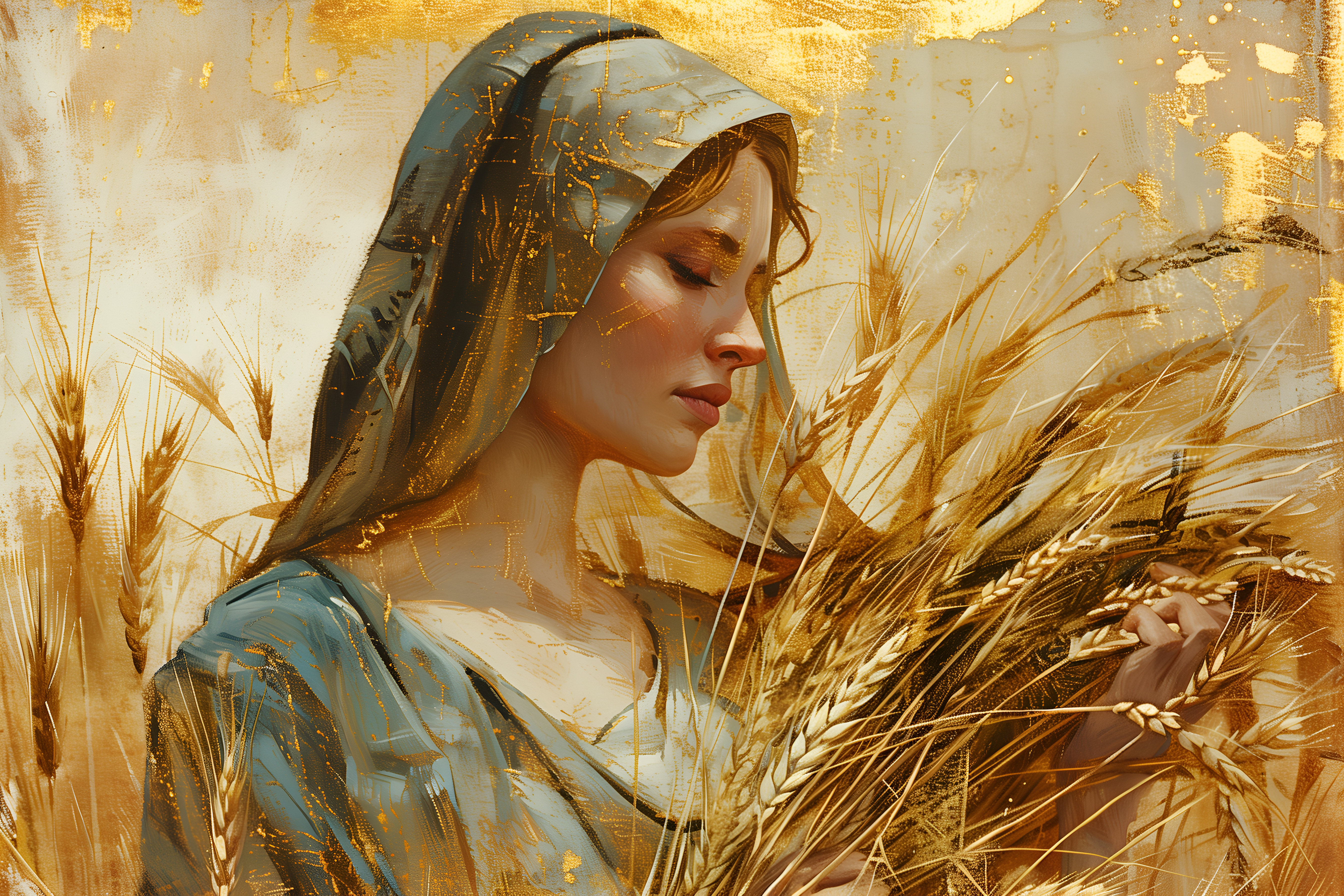
Ruth was more than welcome to work in Boaz’s field. Time passed, and Naomi soon suggested that Ruth could benefit more from being in Boaz’s company than from being his employee; perhaps she could be his wife. Ruth bravely went along with Naomi’s plan to see this become a reality.
Boaz’s response to Ruth was a complete act of generosity and kindness. Not only did he compliment her and say she was a woman of noble character, but he also told her the steps he needed to take to be her guardian-redeemer, which included marriage to her.
The meaning of the guardian-redeemer or kinsman redeemer meant that a relative in the family who was able to restore the broken circumstances of a family member who had become poor or in need, to improve their life situation. The Hebrew word gōʾēl describes the kinsman redeemer, like this: “The gōʾēl, then, was a near kinsman who acted as protector, defender, avenger or rescuer for other members of the family, especially in situations of threat, loss, poverty, or injustice. Such action would always involve effort, often incurred cost, and sometimes demanded a degree of self-sacrifice.”[i]
Kinsman-Redeemer
Boaz was a kinsman redeemer marrying Ruth and making her and Naomi a part of his family, thereby restoring wealth and giving them a family.
God as a redeemer is first found in the Old Testament when God brought the Israelites out of Egypt, out of oppression, out of living under the control of the pharaoh, and out of bondage. God redeemed Israel. The idea of a kinsman redeemer is found in Leviticus 25:25–28, 47–52 and is the concept of a close family member restoring property or freeing the life of slavery, with a price.
Sin puts humans in slavery and bondage, meaning that we need to be released from such a state.[ii] That is why all people need a redeemer. Redemption is close to the concept of ‘salvation,’ however, ‘redemption’ tells us how we are saved, which is with a price or a ransom.[iii] It is apt that Jesus has the role of kinsman-redeemer. He came to the world as a human, more specifically to a Jewish heritage.[iv] Jesus is called the new Adam or new human and has close ties to everyone in the world. “In the exodus, God delivered the Israelites from slavery to Egypt. And through the cross of Christ, God delivered us from slavery to sin.”[v]
This New Testament passage shows how Jesus is our redeemer and that Jesus has paid the price with His blood to redeem us from our sins:
“For you know that it was not with perishable things such as silver or gold that you were redeemed from the empty way of life handed down to you from your ancestors, but with the precious blood of Christ, a lamb without blemish or defect. He was chosen before the creation of the world, but was revealed in these last times for your sake. Through him you believe in God, who raised him from the dead and glorified him, and so your faith and hope are in God.” 1 Peter 1:18-21
Jesus didn’t use money or gold to pay for our redemption. “He stepped in to pay the price for each of us, when we were poor and in need.”[vi] He saved us from our state of being in sin and has restored our connection with God. We have new life in Jesus, and are made clean through His blood, we are able to connect with God through prayer and worship. We don’t need to live in the hopelessness of a sinful life, but we are free to honour God with our lives and bring glory to His name.
Just as Ruth and Naomi’s future prospects were restored through Boaz, their kinsman-redeemer, our future hope and purposes are restored and redeemed through our Redeemer, Jesus.
[i] Christopher J. H. Wright, The Mission of God: Unlocking The Bible’s Grand Narrative (La Vergne: IVP, 2020).
[ii] Robert A. Peterson, Salvation Accomplished by the Son: The Work of Christ (Wheaton, IL: Crossway, 2011), 103.
[iii] Daniel J. Treier, Kevin J. Vanhoozer, and Nicholas Thomas Wright, eds., Theological Interpretation of the New Testament: A Book-by-Book Survey (London: SPCK, 2008).
[iv] Wright, The Mission of God.
[v] Wright, The Mission of God.
[vi] Bream, Love Stories of the Bible Speak, Biblical Lessons on Romance, Friendship and Faith, 131.