“Leave Me Alone”: Divine Pathos, Prophetic Intercession, and the Repentance of God in Exodus 32:7–14 – Part 2
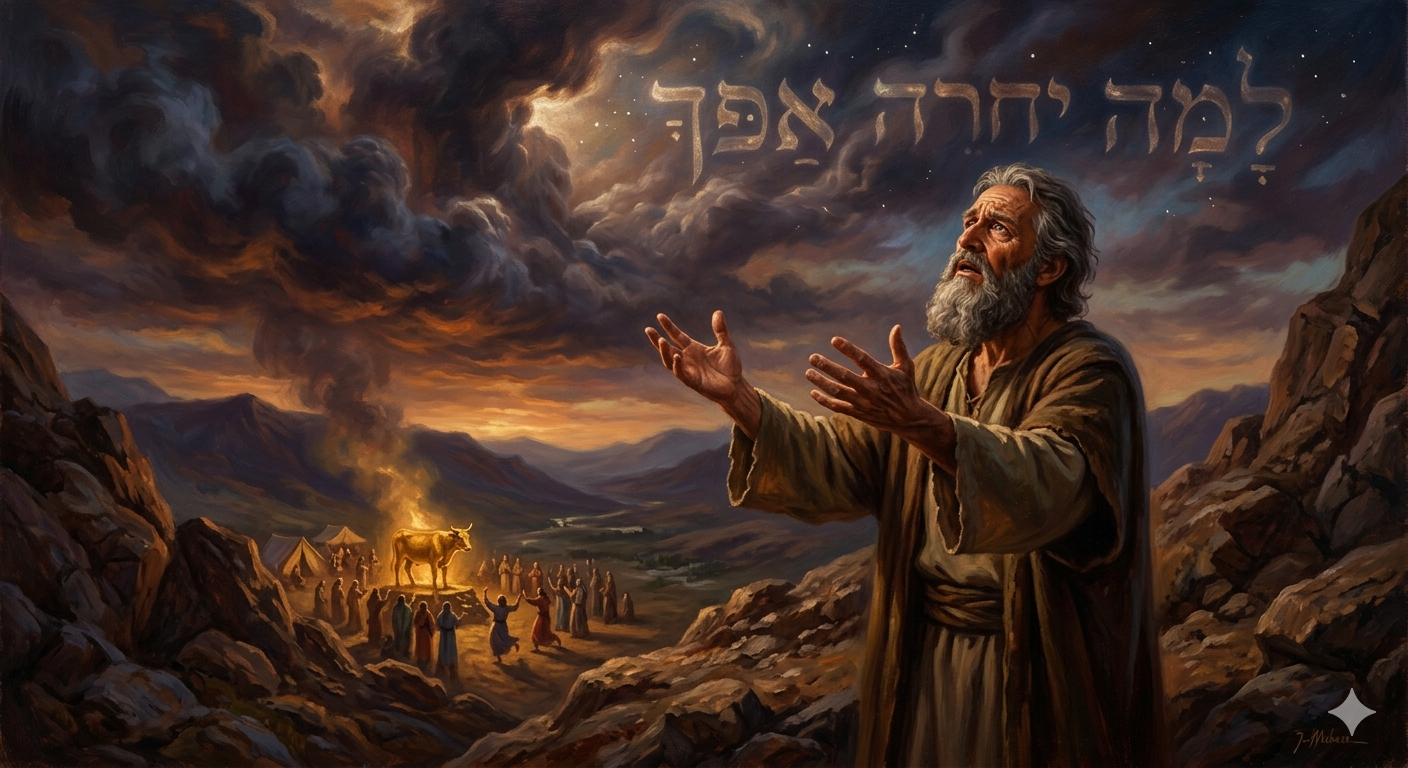
“Why does your anger burn” (Exodus 3212)
A Close Reading of Exodus 32:7–14
The Transfer of Ownership and the Irony of “Your People”
The dialogue in Exodus 32:7–14 opens with God addressing Moses in an immediately startling manner. Rather than speaking of “my people,” the standard covenantal designation for Israel, God says: “Go down at once! Your people, whom you brought up out of the land of Egypt, have acted perversely” (Exod 32:7, NRSV, emphasis added). The rhetorical effect of this transfer of ownership is profound. At the very moment when Israel has most flagrantly violated the covenant, God implicitly disowns them by attributing them to Moses. The people who were redeemed through divine power, who crossed the sea by the outstretched arm of the LORD, are now described as the people whom Moses brought out of Egypt.
The irony is sharp and intentional. The narrative has already established beyond any doubt that it was God who sent the plagues, who opened the sea, and who led Israel through the wilderness by pillar of cloud and fire. Moses’ own intercession in verses 11–13 will correct this distortion explicitly: “O LORD, why does your wrath burn hot against your people, whom you brought out of the land of Egypt with great power and with a mighty hand?” (Exod 32:11, NRSV emphasis added). Moses refuses to accept the transfer of ownership. By insisting on the second person, you brought them out, Moses holds God to the logic of the divine initiative. Israel remains God’s people precisely because God chose and redeemed them.
Terence Fretheim, in his commentary on Exodus, notes that the entire golden calf debacle demonstrates what is ultimately at stake in Israelite covenant life: “The peril for Israel is not that this or that commandment will be disobeyed but that it will be disloyal to Yahweh and serve other gods. The golden calf debacle demonstrates this. Israel’s future as the people of God is centered on this matter.”[9] Moses, in other words, will not collude with God’s momentary impulse to disown Israel. He insists on the continuity of the covenant even as the covenant is being broken.
“Leave Me Alone”: The Dynamics of Divine Permission
The phrase “leave me alone” (Exod 32:10) has attracted considerable attention from commentators. On a straightforward reading, God commands Moses to cease intercession so that divine wrath may proceed unimpeded. The command seems to anticipate precisely what Moses goes on to do: intercede boldly on Israel’s behalf. Why, then, does God issue a command to leave him alone if he is not yet being challenged?
Several interpreters have proposed that the very formulation of the command implies an implicit invitation to intercede. By saying “Leave me alone,” God opens a rhetorical space in which Moses may choose not to leave God alone. Fretheim argues in The Suffering of God that God’s openness to the future is constitutive of the divine character: “The world is not only affected by God; God is affected by the world.”[10] This mutuality means that God’s announced judgments are genuine responses to human action, not immutable decrees, and therefore susceptible to reversal when circumstances change through intercession.
Fretheim further clarifies the relationship between prayer and divine action, arguing that prayer serves as a God-given means for God’s people to make a situation more open to God.[11] On this reading, God is disclosing to Moses the gravity of the situation and, in doing so, implicitly summoning Moses to exercise his intercessory role. The announcement of judgment itself becomes the occasion for the prophetic intercession that can avert it.
This reading finds support in the parallel from Amos 3:7: “Surely the Lord GOD does nothing without revealing his secret to his servants the prophets” (Amos 3:7, NRSV). Before executing judgment, God characteristically discloses the divine intention to the prophetic intercessor. The same pattern appears in Genesis 18:17, where God asks, “Shall I hide from Abraham what I am about to do?” and then proceeds to engage Abraham in an extended dialogue about the fate of Sodom and Gomorrah. The pattern in Exodus 32 is structurally identical: God announces the intended judgment, and the announcement itself becomes the occasion for prophetic intercession.
Psalm 106:23 offers the Old Testament’s own retrospective interpretation of the event: “Therefore he said he would destroy them—had not Moses, his chosen one, stood in the breach before him, to turn away his wrath from destroying them” (Ps. 106:23, NRSV). The metaphor of standing in the breach is drawn from the imagery of siege warfare, where a defender stands in a gap in the city wall to hold back an invading army. Moses stands in the breach between the divine wrath and the people of Israel, and the testimony of the Psalter is that this intercession was decisive.
The Rhetoric of Intercession: Honor and Consistency
Moses’ intercessory argument in verses 11–13 operates on two levels. The first is the appeal to divine reputation. Moses asks: “Why should the Egyptians say, ‘It was with evil intent that he brought them out to kill them in the mountains, and to consume them from the face of the earth’?” (Exod. 32:12, NRSV). This argument exploits the gap between God’s stated purposes and the consequences of executing judgment. If God destroys Israel in the wilderness, the surrounding nations will draw the conclusion that the God of Israel is either malevolent or incapable of accomplishing what he began. The divine honor is thus implicated in the survival of Israel.
The second level of Moses’ argument is the appeal to the patriarchal promises. Moses invokes the covenant with Abraham, Isaac, and Jacob, and the oath God swore to multiply their descendants and give them the land (Exod. 32:13). This appeal holds God accountable to specific, historically grounded commitments. The destruction of Israel would constitute a divine breach of covenant, a failure to keep sworn promises.
What is theologically remarkable about this argument is its implicit model of the divine-human relationship. Moses does not simply beg; he reasons with God. He treats God as an agent capable of being persuaded by legitimate arguments and held accountable to prior commitments. This picture of God is incompatible with the Aristotelian Unmoved Mover but entirely consistent with the covenantal God of the Hebrew Bible. As Fretheim observes in his commentary on Exodus, “The decision (will), insight (knowledge), and energy of the intercessor are placed in the service of God.”[12] Moses’ rhetorical and moral energy becomes itself a resource that God employs in determining the divine response to Israel’s apostasy.
The Repentance of God
The climax of the passage is the statement of verse 14: “And the LORD repented of the disaster that he planned to bring on his people” (Exod 32:14, author’s translation). The Hebrew verb naḥam in the Niphal stem carries a range of meanings, including to be sorry, to relent, to change one’s mind, and to be comforted. When applied to God in a context of announced judgment, it consistently denotes a genuine reversal of intention, a change in the divine course of action.
The theological implications of this statement have been contested throughout the history of interpretation. Classical theism, committed to divine immutability, has generally argued either that the repentance of God is anthropomorphic language that must not be pressed literally or that what appears as a change in God is, in reality, a change in the human situation to which God’s consistent will responds differently. Both moves impose constraints upon the text that the text itself does not impose.
Fretheim argues with considerable force that the biblical tradition’s regular use of naḥam with God as subject cannot be dismissed as mere accommodation. His central claim about divine suffering applies directly here: the aim of the Old Testament’s anthropopathic God-language is to show that “suffering belongs to the person and purpose of God.”[13] The repentance of God in Exodus 32:14 is not a theological embarrassment to be explained away; it is a theological affirmation to be received and pondered. To read these occurrences as simply metaphorical is to evacuate the narrative of its dramatic and theological force.
The Prophet as Intercessor
Intercession as a Constitutive Prophetic Function
The scene in Exodus 32 illuminates a dimension of the prophetic vocation that is sometimes overshadowed by the emphasis on the prophet as proclaimer of the divine word. The prophet in the Old Testament is not only a messenger who carries God’s word to the people; the prophet also carries the people’s cause before God. This intercessory function is constitutive of the prophetic office, not peripheral to it.
Samuel’s farewell address makes the point explicitly: “Moreover as for me, far be it from me that I should sin against the LORD by ceasing to pray for you” (1 Sam 12:23, NRSV). For Samuel, the failure to intercede would itself constitute a sin. Jeremiah’s situation is particularly instructive for the present discussion. God commands Jeremiah on three separate occasions not to intercede for the people (Jer. 7:16; 11:14; 14:11). The very repetition of the prohibition suggests that Jeremiah continued to intercede despite the command. The prophetic impulse to stand in the breach was stronger than the divine command to step back, a paradox that illuminates the peculiar freedom that the covenant relationship granted to the prophets.
Ezekiel 22:30 offers perhaps the most poignant formulation of the prophetic intercessory ideal: “And I sought for anyone among them who would repair the wall and stand in the breach before me on behalf of the land, so that I would not destroy it; but I found no one” (Ezek. 22:30, NRSV). The absence of an intercessor becomes itself a theological explanation for the coming judgment. When there is no one to stand in the breach, the divine wrath proceeds unimpeded. The existence of the intercessor is thus not a marginal phenomenon but a structural element in the economy of divine-human relations as the Old Testament conceives it.
The Psalmist’s Witness: Psalm 106:23
Psalm 106 provides the canonical Old Testament commentary on the golden calf incident and, in particular, on Moses’ intercessory role. The psalm surveys Israel’s history of rebellion and divine forbearance, and its account of the Exodus 32 episode is theologically precise: “Therefore he said he would destroy them—had not Moses, his chosen one, stood in the breach before him, to turn away his wrath from destroying them” (Ps 106:23, NRSV). The conditional construction of the sentence is significant: the destruction was determined, and it was averted by the intercession of Moses.
The language of “standing in the breach” invests Moses’ action with a heroic, almost military quality. He is not simply making a request; he is blocking the path of the divine judgment. The psalm affirms what Exodus 32 narrates: that prophetic intercession is a genuine causal factor in the history of Israel, not a mere formality that God graciously accommodates. As Heschel reminds us, this is what it means for the prophet to share in the divine pathos: “The prophet disdains those for whom God’s presence is comfort and security; to him it is a challenge, an incessant demand.”[14]
Psalm 94:16 and the Divine Vulnerability
A striking parallel to the dynamics of Exodus 32 appears in Psalm 94:16, where the psalmist records a question that can only be read as a divine utterance: “Who rises up for me against the wicked? Who stands up for me against evildoers?” (Ps 94:16, NRSV). Interpreted within the framework developed above, this divine question expresses the same need that the “leave me alone” of Exodus 32 implicitly expresses: a need for the human intercessor who will stand alongside God against the forces that threaten the covenant relationship.
This is not a diminishment of divine sovereignty but a reflection of the covenantal structure within which divine sovereignty operates. As Muffs observed in his description of the Israelite prophet, God does not act in isolation but in genuine dialogue. The prophet acts as an independent advocate who gives voice to the divine pathos and, at the same time, shapes its expression through the courage of loyal intercession. The God who asks “who will stand up for me?” is the same God who said “leave me alone” to Moses: a God who invites precisely the human engagement that his sovereignty might seem to preclude.
To Be Continued
Notes
[9] Terence E. Fretheim, Exodus, Interpretation: A Bible Commentary for Teaching and Preaching (Louisville: John Knox Press, 1991), 285.
[10] Terence E. Fretheim, The Suffering of God: An Old Testament Perspective, Overtures to Biblical Theology (Philadelphia: Fortress Press, 1984), 45.
[11] Fretheim, The Suffering of God, 62.
[12] Fretheim, Exodus, 288.
[13] Fretheim, The Suffering of God, 1.
[14] Heschel, The Prophets, 26.
Claude Mariottini
Emeritus Professor of Old Testament
Northern Baptist Seminary
If you enjoyed reading this post, you will enjoy reading my books.
VISIT MY AMAZON AUTHOR’S PAGE
BUY MY BOOKS ON AMAZON (Click here).
NOTE: Did you like this post? Do you think other people would like to read this post? Be sure to share this post on Facebook and share a link on X so that others may enjoy reading it too!
If you are looking for other series of studies on the Old Testament, visit the Archive section and you will find many studies that deal with a variety of Old Testament topics.