Knowledge Within Bounds?
By Elizabeth Prata

I am reading John Milton’s incredible book Paradise Lost. Milton’s use of language to bring the tangible to our mind, while still maintaining a balance of the ephemeral (because how can one really describe heaven, hell, Paradise, and the cosmos with certainty?) is unparalleled. You see Eden with your imagination, and ever more so, you feel it with your heart.
“Milton’s style in Paradise Lost is rich and full of splendour; it is replete with numerous deliberate devices that heighten dignity and govern imaginative and emotional response,” writes the author of this study guide.
Milton stuck with the poetic conventions of the Epic poem, so there are dialogues and soliloquies. In this scene from Book 7, Adam is in Paradise, unfallen as yet. Adam is hosting an angel from heaven, Raphael. God had sent Raphael to Adam to warn him that the fallen angel now called Satan is going to tempt Adam in an effort to corrupt him.
In this dialogue, the Archangel Raphael does warn Adam. As the discussion continued, Adam asked Raphael to relate the moments when God created the world. He was curious about life before he was created and his own creation moment.
Milton wrote the dialogue in an elegant way to warn of the dangers of unchecked intellectual curiosity. While it is good to be curious about some things, pursuing knowledge beyond the bounds of God’s limits is of no profit. Raphael warns Adam that he should pursue only the knowledge that glorifies God, and that which maintains his own happiness in his worship of God. Pursuing knowledge beyond the bounds turns wisdom into folly and the pursuer into a fool.
The angel said that while knowledge sustains the mind, he must know how to consume it in moderation. Over-indulging in trying to comprehend mysteries beyond human bounds is not good, saying- “Of knowledge within bounds; beyond abstain”.
But Knowledge is as food, and needs no less
Her Temperance over Appetite, to know
In measure what the mind may well contain,
Oppresses else with Surfeit, and soon turns
Wisdom to Folly, as Nourishment to Wind.
Paradise Lost (Book VII, lines 126-130)
Just as we must not overindulge in eating food for the stomach, we must restrain ourselves from overindulging in food for the mind as well.
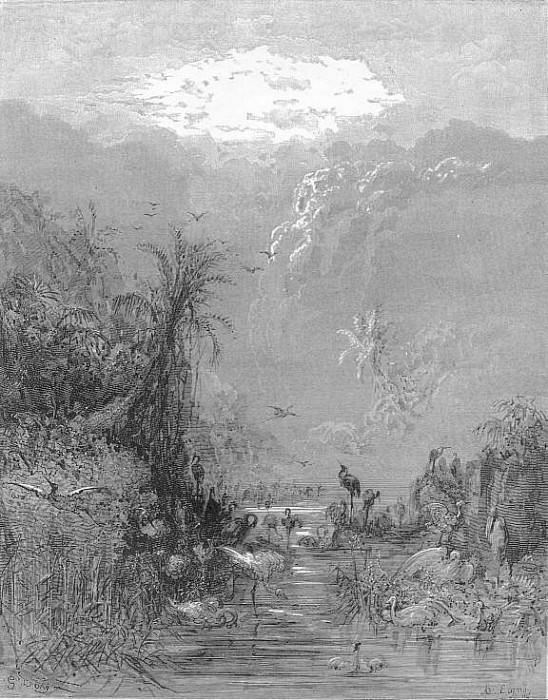
In Paradise Lost, when Adam asked to learn about the creation of earth, he asked humbly and stated his purpose for wanting to know-
“not to explore the secrets ask
Of his Eternal Empire, but the more
To magnify his works, the more we know.”
Pursuing knowledge to glorify God is a good pursuit. We can praise Him and worship Him properly. But like anything, it can be turned into a idol. If the person over time drifts from his purpose of learning in wanting to magnify God, into learning for its own sake, or worse, to puff up, then it is of no use.
The verse in 2 Timothy 3:7 reminds us that in the last days difficult times will come, where there will be some who are “always learning and never able to come to the knowledge of the truth“.
King Solomon, the wisest man to ever live, warned against obtaining too much knowledge. He said in Ecclesiastes 7:16,
Do not be excessively righteous, and do not be overly wise. Why should you ruin yourself?
Here, knowledge puffed up to the point of the person either being conceited among brethren, or contending with God. Think of Job’s friends. They had massive knowledge and their doctrine was correct. However, they were so strict in their doctrine, the friends dogmatically believed suffering was always a direct consequence of sin. They aggressively applied this rule to Job’s situation, and their knowledge led to advice that became presumptuous and improperly used.
The beginning of wisdom is: Acquire wisdom; And with all your possessions, acquire understanding. (Proverbs 4:7).
People pursue knowledge, which is an accumulation of facts. But what good is a heap of facts without ability to apply it wisely? For this is wisdom.
The Lord revealed what He wanted to reveal in His word. Pursuing wisdom is a good thing, but must be done wisely and moderately, not going beyond the bounds.
Unchecked curiosity into the deeper realms beyond God’s revelation to us is unwise. Seeking to understand things beyond human capacity overwhelms the mind and turns wisdom into folly.