Hypnosis: Therapy, Trend, or Spiritual Danger?
From Pagan Sleep Temples to Hypnobirthing: Nothing New Under the Sun
By Elizabeth Prata
Should a Christian undergo hypnosis to ingrain new behavior patterns and dispense with unwanted desires or actions? Isn’t hypnosis just a benign way to relax or reduce anxiety? Is it wrong to use hypnosis when giving birth? (hynobirthing). This essay explores hypnosis from a Christian point of view.
Hypnosis is a popular activity in today’s cultures. We see it on the television show The Mentalist, in movies, and seen used nearly universally in most cultures throughout history at one time or another in therapies of one kind or another.
Hypnosis is used for everything to helping a patient cease an undesired behavior (like smoking), or for relaxation, or even entertainment (along the lines of comedians or magicians). But is hypnosis desirable for a Christian to use?
First, what IS hypnosis?
Hypnotherapy is a heightened state of concentration and focused attention. A trained, certified hypnotist or hypnotherapist will guide you. Hypnosis allows you to be more open to suggestions about making healthful changes in your perceptions, sensations, emotions, memories, thoughts or behaviors. Source Cleveland Clinic .
Yes, but it is also so much more.
At its root, hypnosis when used in medicine or therapy is a method in which the patient hopes to bring about a change. That is basically what hypnosis is, the patient needs a change, whether it is from a bad habit to a good, from an illness to being well, from depression to joy, they want and need a change in some way, so they employ hypnosis.
So, how does the desired change occur in using hypnosis?
According to the Cleveland Clinic, there are 4 stages to a hypnotherapy session:
- Induction
- Deepening
- Suggestions
- Emergence
It’s important to take note that hypnosis always begins with an induction. The person is induced to the altered mental state. The hypnotic state is not like a trance we go into when we’re at a red light traffic stop. It’s not when we look out the window of our work space and daydream about vacations. This is not accidental, it is not daydreaming, it is induced and once a person is ‘under,’ it has an intention. What does induced mean in medical terms? ” to cause or initiate by artificial means”. An external cause is applied to the mind to induce this suggestible state.
Thus, the 3rd step in a hypnosis session involves suggestions. The “hypnotherapist will use imagery and carefully chosen language. They’ll gently suggest that you change how you think, act or respond to something.” (Source).
Don’t be swayed by the use of the word ‘gently.’ The key is that hypnosis bypasses the conscious, critical mind. There is what hypnotherapists call the ‘judgmental filter‘ between the conscious and unconscious mind, and hypnosis lessens this barrier. When a patient is ‘under’, she can then access deeper thought patterns hiding in her subconscious, allowing for a “mindset reset” to eliminate ingrained behaviors or limiting beliefs.
I understand that a person may have tried to quit their alcoholism, their workaholic state of mind, their overeating, smoking, anger issues, whatever they seek to change. They want to overturn their ‘limiting belief’ underlying their behavior, beliefs such as ‘I’m not good enough’, ‘I am a failure’, ‘I hate myself’, which may be the belief giving rise to the unwanted behavior they seek to change. Their subconscious limiting belief and their conscious behavior are connected, as the hypnotist teaches.
Firstly, according to Stanford University, “Only about 10 percent of the population is generally categorized as “highly hypnotizable,” while others are less able to enter the trancelike state of hypnosis.” The Association of Certified Biblical Counselors (ACBC) uses the figure of 15%. So, there are very few people in which the hypnotic state can even be induced.
And, do you trust yourself enough, or trust the therapist enough, with your very mind? ACBC reported, “Dr. Amir Roz is a professor in the department of psychiatry at McGill University. He researched hypnosis and what is happening in the human brain with that procedure. He found that hypnosis actually turns off certain portions of the brain. There are portions of the brain that are lit up and active when a person is not in a hypnotic state, and those regions of the brain are put to sleep, so to speak, when a person is under a hypnotic state.” excerpt.
If you are a Christian, you know we seek to honor God with all we think, say, and do. How does the Bible address our desire to change? How does the Bible tell us how our minds change? What is in our subconscious, anyway?
We are told in the Bible that yes, there exists a person who introduces suggested behaviors and our responses to external stimuli- the Holy Spirit. He transforms the mind. The method He uses is not an altered state of consciousness, but God’s word. Romans 12:2 says not to be conformed to this world, which by the way IS our subconscious, and it is our conscious mind, too, but be renewed by the transformation of it. We do this by replacing negative, worldly thoughts with biblical truth, which transforms the mind and enhances our choice to engage in resulting actions that are aligned with God’s will.
What is in our subconscious? More depravity. We definitely do not want to unearth the depravity that is in our worldly mind and lessen the critical, analytical links we possess in order to succumb to suggestibility. We need something external to us to change our mind, heart, will, and actions. And that external person is not the hypnotist.
The hypnobirth craze
“A branded version of hypnosis during the birthing process is referred to as HypnoBirthing.” (Healthline).
Hypnosis is being used in labor. Midwives are teaching hypnobirth techniques and this trend is massively on the rise. CBS says that enrollments in hypnobirthing courses have doubled recently. Lamaze classes are spoken of in the past tense.
Hypnosis in obstetrics is not new. “Russian medicine has had extensive experience with obstetric hypnosis. Platanov, in the 1920s, became well known for his hypnoobstetric successes. Impressed by this approach, Stalin later set up a nationwide program headed by Velvoski, who originally combined hypnosis with Pavlovian techniques but eventually used the later almost exclusively. Ferdinand Lamaze, having visited Russia, brought back to France “childbirth without pain through the psychological method,” (A primer of clinical hypnosis, 1985, also here)
The craze in today’s time that has seduced women is ‘hypnobirthing’. This is a trend which involves hypnosis, performed either by a midwife, hypnotherapist, or the woman in labor herself, to achieve what is touted as a “pain-free childbirth.” If you believe that you can achieve a childbirth that is free from pain through your own efforts, you are deluded. Why? God promised women pain in childbirth.
To the woman He said, “I will greatly multiply your pain in childbirth, in pain you shall deliver children;” (Genesis 3:16a).
Modern woman: ‘I can hypnotize myself into having no pain during the birth of my baby. God’s promise of pain during childbirth has no hold on me. My personal will and effort overcomes God’s words.’
This writer is speaking positively of hypnobirth, which is hypnosis used during childbirth says the following: “In its most basic form, hypnosis is positive affirmations paired with deep relaxation.”
IS it? Yes. But it is so much more, too, including things that the Christian woman should consider very seriously if she is mulling a hypnobirth method. As mentioned above, we are altering our brain by forcing parts of it to become inactive, we are trusting an external person to suggest alternate behaviors to us, a person not the Holy Spirit and suggestions not from the Bible.
I’ve read on several credible sites the claim that “the Bible predates hypnotism”. The claim is that hypnotism is relatively new, starting with Franz Mesmer in the 1700s. No. It’s not new. Neither is hypnobirth.
Though Franz Mesmer popularized it in the late 1700s, hypnotism actually emerged in ancient Egypt during the time of Imhotep in around 3000 BC. It was used then as it is now as a therapy for healing, using utilizing guided imagery, suggestion, and rituals to induce trance-like states for the patient seeking relief. It’s nearly impossible to find a culture that didn’t use hypnosis or induced trances in one form or another. From Egypt in 3000 BC or earlier to ancient Greece to Shamans in Siberia, Native American, or African cultures, to fakirs of India and so on, induced trances to aid in physical ailments, pain, or illness. This method has been as common as humans have been on earth. Shamans, Fakirs, Magi, Priests, have all used it throughout history.
Sleep Temples, AKA Asclepion
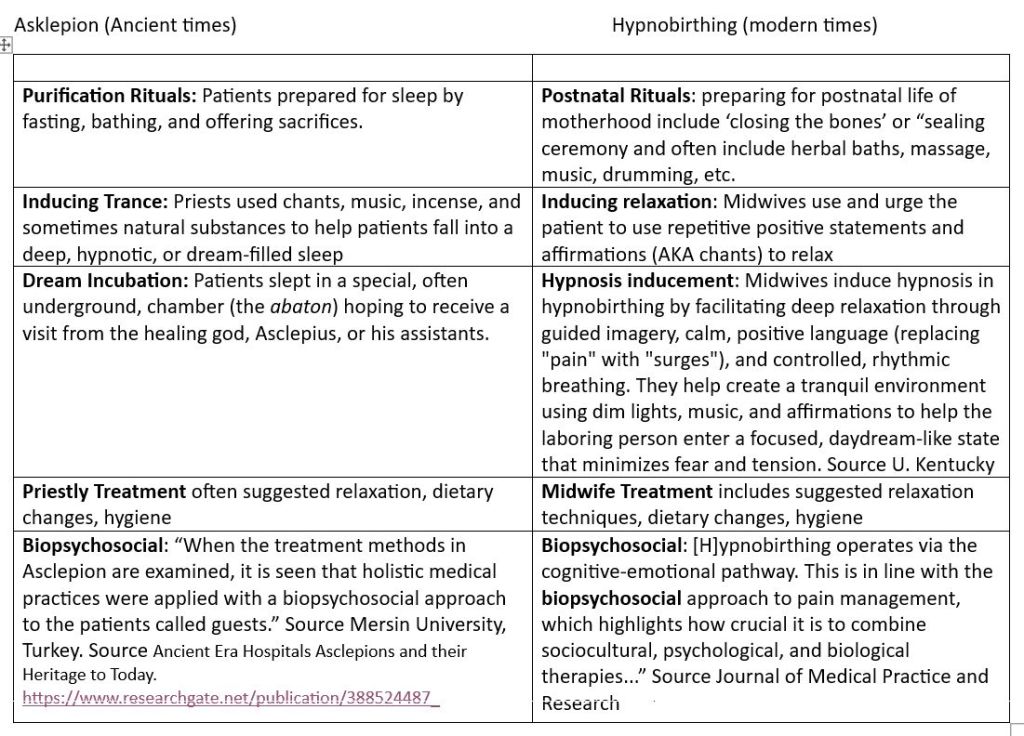
As I read about hypnobirth and the ancient Asclepion, I noticed similarities in the approaches to wellness, the rituals, and the care of the patients.
The ancient world sure loved their gods. Ephesus had Artemis and the temple, Corinth had Poseidon, Athens had Athena, and Pergamos had Asclepius.
Asclepius was the god of healing. He was often depicted as a man with a rod with a snake entwined around it. Our modern medicine symbol stems from this depiction of Asclepius. He was absolutely a rock star in the ancient world and his ‘hospital’ or healing center in Pergamos was the largest in the known world.
In the hospital/wellness center AKA Asclepion, ‘medical, herbal, paramedical treatment and rarely, surgical, treatments intertwined through suggestion and belief.’ (Source).


Between Greece and Turkey about three hundred and twenty Asclepion were built.
Egyptian Dream Temples: Healing Through Dreams– “This practice wasn’t just spiritual—it was deeply therapeutic. These temples served as early wellness centers where emotional and physical ailments were addressed holistically.”
In Greek mythology, god Hypnos was regarded as healing and relieving people from pain and as a way to connect with the gods. Source Sleep Medicine Volume 130, June 2025
The Pergamos Asclepion was a medical school for the training of famous physicians of the period, notably, Galen. It was the world’s first psychiatric hospital. This asclepion appears to be the first place of application of physical therapy and rehabilitation and psychiatry departments in the history of medicine, with the application of hot water springs, physical therapy practices and suggestion treatment methods (aka hypnosis).
The methods used in the ancient Asclepion are remarkably similar to those used in hypnobirthing today.
In Asclepion, priests used hypnosis, or induced sleep therapies in treatments for many different general illnesses. In hypnobirth, hypnosis is used specifically for childbirth.
Conclusion
What has been, it is what will be,
And what has been done, it is what will be done.
So there is nothing new under the sun.
Ecclesiastes 1:9
Roy Gingrich has a comment on that verse:
” The labor that is going on in the human creation today is the same labor that was going on in the human creation in Cain’s day. Men today pursue the same things (wealth, fame, power, pleasure, education, etc.) that men pursued in times past and the same things that men will pursue in times future.”
” If men say “here is a new pursuit, one that has never been tried before, one that will lead to contentment and rest,” they have carelessly forgotten that men of former generations followed that pursuit and failed to find satisfaction and rest. The men of future generations will be just as careless in forgetting the pursuits and failures of those who have gone before them.” Gingrich, R. E. (1995). The Book of Ecclesiastes (p. 11). Riverside Printing.
If you are contemplating using hypnotism for a physical, behavioral, or mental ailment, please understand what you are getting into. We are called to be sober minded and have sound judgment. (1 Peter 4:7).
What does the Bible say about accepting any other spiritual concept? Many of the rituals and activities joined with hypnosis or from hypnosis are from other religions.
If you say that you’re wise enough to sift through the foo-foo stuff in your quest to use hypnosis, as in ‘I can eat the meat and spit out the bones’, be aware that we are called to pursue pure spiritual milk (1 Peter 2:2), not meat infested with bones.
We forget how childlike we are, foolish, finite, and immature. We cannot accept an iota, a jot, or a tittle of any other spirituality, because we cannot handle it. Most people forget or reject this fact. They think, Oh, not me, I can handle it! WE CAN’T. Read Judges.
Hypnosis may or may not be successful for you. That is not the point.
“This is about God loving His people and us trusting His care to do what He says we need to do when we know we need to change, and not trusting the suggestions of an outside person who wants us to place our minds in a passive state.” Hypnosis and the Bible
Are you honoring God in your pursuit of transformation? Are you drinking pure spiritual milk, or are you allowing a mixture of New Age or other religious streams of thought into your mind? Are you willing to allow your brain to stop functioning in certain areas of it in order to bypass the hard work of renewal?
When we come to the Bible, we come to a book, we come to God’s Word to us that has serious concerns about the practice of hypnotism. (ACBC Hypnosis and the Bible).
Think about these things.
Further Reading
The Ministry of Christ to His Church, sermon
Should a Christian ever get involved with hypnosis/hypnotism?, GotQuestions
Hypnosis and the Bible, Association of Certified Biblical Counselors