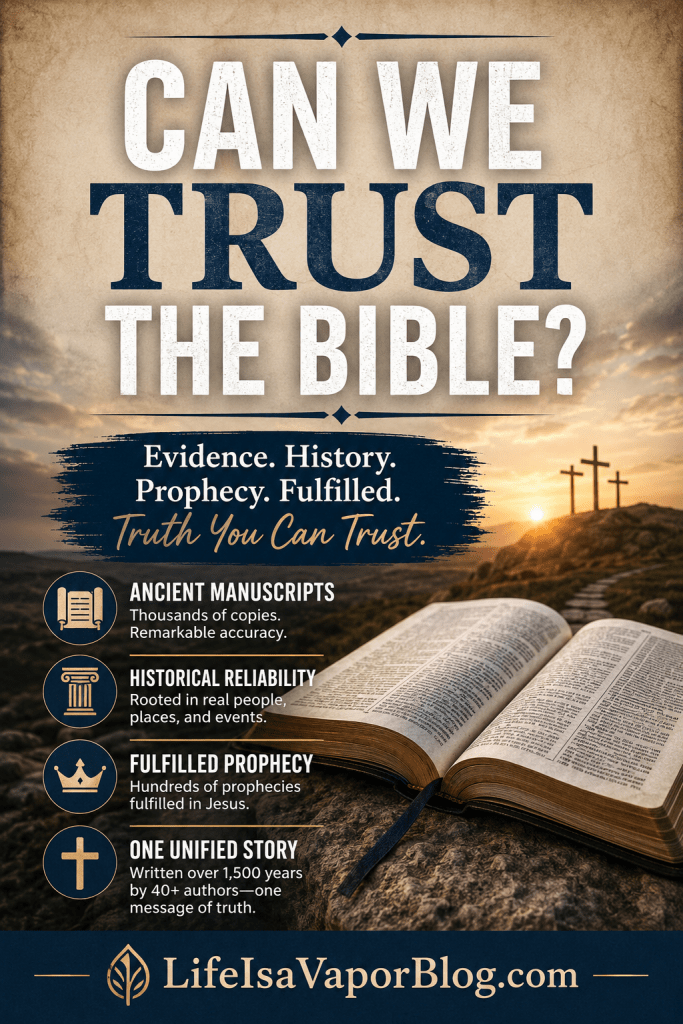
Can We Trust the Bible?
“The grass withers, the flower fades, but the word of our God will stand forever.” — Isaiah 40:8 (ESV)
Have you ever wondered whether the Bible we read today is actually the same Bible that was written thousands of years ago?
You’re not alone.
Whether you’ve heard skeptics question the Bible’s accuracy or you’ve wrestled with doubts yourself, it’s a fair question. After all, the Bible was written centuries ago. It has been copied by hand, translated into hundreds of languages, and passed down through countless generations. So how can we know that what we’re reading today is trustworthy?
Some people assume Christians simply accept the Bible by blind faith. But the truth is that there is a mountain of evidence supporting the reliability of Scripture. While faith is certainly involved, Christianity is not built on wishful thinking. It’s built on historical events, eyewitness testimony, fulfilled prophecy, and a remarkably preserved collection of ancient writings.
Let’s take a look at why Christians throughout the centuries have trusted the Bible—and why we still can today.
Related: What Is the Gospel? A Clear and Biblical Explanation of the Good News
Common Objections to the Bible’s Reliability
Before we look at the evidence, it’s worth considering some of the most common reasons people doubt the Bible’s reliability.
Some argue that the Bible has been copied and translated so many times that its original message has been lost. Others claim that the Bible is filled with contradictions or historical inaccuracies. Still others dismiss Scripture as a collection of myths and legends written long after the events they describe.
These objections may sound convincing at first, especially if you’ve never examined the evidence for yourself. But here’s the good news: Christianity has never feared honest questions. In fact, many of the strongest arguments for the reliability of the Bible have emerged precisely because scholars, skeptics, and believers have carefully investigated its claims.
As we’ll see, the evidence surrounding the Bible’s preservation, historical accuracy, fulfilled prophecy, and eyewitness testimony provides compelling reasons to trust that Scripture is exactly what it claims to be—the trustworthy Word of God.
“Once the highest view of Scripture is abandoned… the downhill slide in both theology and practice is inevitable.” — James R. White, Scripture Alone
Has the Bible Changed Over Time? Examining the Manuscript Evidence
One of the most common objections to Christianity is the claim that the Bible has been changed over the centuries.
Maybe you’ve heard someone say, “The Bible has been translated so many times that nobody knows what it originally said.” At first glance, that might sound convincing. But when we examine the evidence, a very different picture emerges.
Before we go any further, let’s clarify what scholars mean when they talk about manuscripts.
A manuscript is simply a handwritten copy of a document. Before the invention of the printing press, every book had to be copied by hand. The original writings of the biblical authors—sometimes called the “autographs”—have not survived. However, we possess thousands of ancient copies of those original writings.
At first, that may sound like a problem. But imagine trying to reconstruct the wording of a letter written centuries ago. If you only had one copy, it would be difficult to know whether any mistakes had been made. But if you had thousands of copies from different times and places, you could compare them and quickly identify any copying errors.
That’s exactly what biblical scholars do. Because we have such a large number of manuscripts, they can compare them with one another and determine with a very high degree of confidence what the original authors wrote. In other words, the abundance of manuscripts doesn’t weaken the reliability of the Bible—it actually strengthens it.
The New Testament is supported by thousands of manuscripts, far more than any other work from the ancient world. Because scholars have so many copies to compare, they can identify copying mistakes and determine with remarkable accuracy what the original authors wrote.
What’s especially encouraging is that the vast majority of textual differences are minor. Most involve spelling variations, word order, or other insignificant details that do not affect any core Christian doctrine.
The Old Testament has an equally impressive story. The discovery of the Dead Sea Scrolls provided manuscripts that were more than a thousand years older than previously known copies. When scholars compared them, they found that the biblical text had been preserved with extraordinary accuracy.
Rather than undermining confidence in Scripture, the manuscript evidence demonstrates how carefully God’s Word has been preserved throughout history.
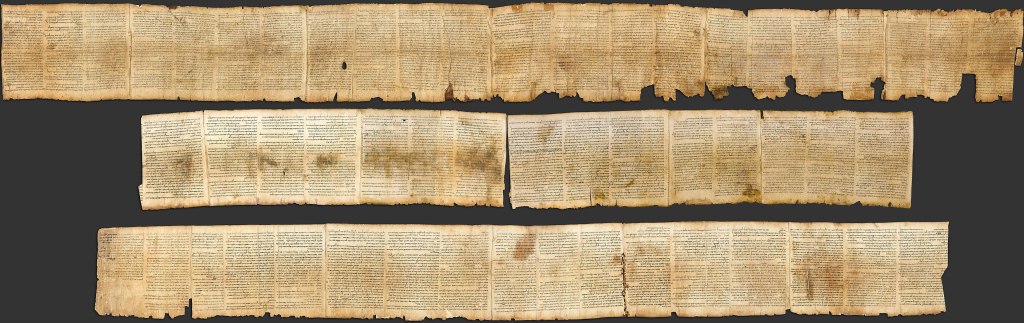
“The evidence for our New Testament writings is ever so much greater than the evidence for many writings of classical authors.”
— F. F. Bruce
Related: 10 Essential Doctrines Every Christian Must Know (According to the Bible)
Is the Bible Historically Reliable?
One thing I love about Scripture is that it doesn’t ask us to check our brains at the door.
The Bible is filled with references to real people, real places, and real historical events. It names kings, cities, nations, and rulers. Luke, for example, begins his Gospel by explaining that he carefully investigated the facts before writing his account (Luke 1:1–4).
Over the years, archaeology has repeatedly confirmed details found in Scripture. In many cases, critics once dismissed biblical accounts as legendary, only to see archaeological discoveries support the Bible’s historical claims.
Archaeology doesn’t prove every aspect of Christianity, but it does demonstrate that the Bible consistently proves itself reliable when tested against history.
Christianity is not built on myths. It is built on events that took place in the real world.
Related: 10 More Essential Doctrines Every Christian Should Know
What Does Jesus Have to Do with the Reliability of the Bible?
Ultimately, every discussion about the Bible leads us to Jesus.
The New Testament writers claimed to be eyewitnesses—or close companions of eyewitnesses—to the life, death, and resurrection of Christ. They didn’t present their accounts as legends. They recorded events they believed had actually happened.
What’s remarkable is that they proclaimed these truths publicly, often at great personal cost. Many endured persecution, imprisonment, and even death rather than deny what they had seen.
People may die for something they mistakenly believe to be true. But few willingly suffer for something they know is a lie.
The eyewitness testimony surrounding Jesus deserves serious consideration, especially because Christianity rises or falls on one event: the resurrection.
If Jesus truly rose from the dead, then everything changes.
Related: 100+ Free Downloadable Resources for Your Spiritual Growth
How Fulfilled Prophecy Supports the Reliability of the Bible
One of the most unique features of the Bible is its predictive prophecy.
Hundreds of years before Jesus was born, the Old Testament foretold details about the coming Messiah. Scripture predicted His lineage, birthplace, rejection, suffering, death, and ultimate victory.
These prophecies were written long before the events they describe, making their fulfillment a powerful evidence for divine inspiration.
The Bible doesn’t simply tell us what happened in the past. It reveals a God who knows the future and directs history according to His purposes.
As Isaiah writes:
“I am God, and there is none like me, declaring the end from the beginning and from ancient times things not yet done”(Isaiah 46:9–10).
Fulfilled prophecy reminds us that the Bible is unlike any other book ever written.
Related: Why Are Christians Hated? What the Bible Says About Persecution
The Unity of Scripture: Evidence the Bible Is God’s Word
Another fascinating evidence for the Bible’s reliability is its unity.
The Bible was written over approximately 1,500 years by more than forty different authors. These writers came from a variety of backgrounds, including kings, shepherds, fishermen, prophets, scholars, and government officials.
Most never met one another.
Yet together they tell one consistent story.
From Genesis to Revelation, Scripture reveals God’s plan to redeem sinners through Jesus Christ. The Old Testament points forward to the Messiah, while the New Testament reveals His coming and explains His work.
Despite being written across centuries and cultures, the Bible never loses sight of its central message.
That kind of unity is difficult to explain apart from divine authorship.
Why Jesus Trusted the Scriptures
For Christians, perhaps the strongest reason to trust the Bible is because Jesus trusted the Bible.
Throughout His ministry, Jesus consistently treated Scripture as the authoritative Word of God. He quoted it, taught from it, and appealed to it as the final standard of truth.
He affirmed the historical accounts of Adam and Eve, Noah, Jonah, Moses, and other figures that many modern critics question.
Jesus declared, “Scripture cannot be broken” (John 10:35) and prayed, “Your word is truth” (John 17:17).
If Jesus is who He claimed to be, then His view of Scripture matters.
In fact, it matters more than anyone else’s.
Does Faith Require Evidence?
Some people assume that faith means believing without evidence.
The Bible presents faith very differently.
Biblical faith is trusting God based on what He has revealed. It is not a blind leap into the dark but a confident response to truth.
Think about it this way. Every day we place trust in things because we have reason to do so. We sit in chairs, drive over bridges, and board airplanes because evidence gives us confidence.
Similarly, Christians trust Christ because God has provided evidence through Scripture, history, prophecy, and the resurrection.
Evidence alone cannot save us, but it can answer questions, remove obstacles, and point us toward the truth.
Faith and evidence are not enemies. They work together.
“Christianity is a faith that is based upon evidence.” – Josh McDowell
Why the Reliability of the Bible Matters Today
At first glance, this discussion may seem like an issue reserved for scholars and theologians.
But it affects every part of life.
When you’re facing uncertainty, can you trust God’s promises?
When you’re suffering, can you trust His character?
When culture tells you that truth is relative, can you trust what Scripture says?
The answer depends on whether the Bible is trustworthy.
If Scripture truly is God’s Word, then it is more than an ancient collection of writings. It becomes the foundation upon which we build our lives.
The psalmist wrote:
“The sum of your word is truth, and every one of your righteous rules endures forever” (Psalm 119:160).
Because God’s Word is true, we can trust it completely.
Can We Really Trust the Bible?
After examining the evidence, the answer is yes.
The Bible has been scrutinized, criticized, challenged, and attacked for centuries. Yet it remains the most influential and best-preserved book in human history.
The manuscript evidence demonstrates that it has been accurately transmitted. Archaeology supports its historical reliability. Fulfilled prophecy points to divine authorship. The testimony of eyewitnesses supports its claims about Jesus. And the unity of Scripture reveals a message far greater than any human authors could have designed.
Most importantly, Jesus Himself affirmed the authority and truthfulness of God’s Word.
While evidence alone cannot produce saving faith, it consistently points us toward the truth of Scripture and the Savior it reveals.
Related: Why Should I Trust God? 7 Biblical Reasons to Put Your Faith in Him
Frequently Asked Questions About the Reliability of the Bible
Which Bible translation is the most accurate?
While no translation is perfect, many modern English translations are highly reliable because they are based on the best available Hebrew, Aramaic, and Greek manuscripts. Faithful translations such as the LSB, ESV, NASB, NKJV, and CSB accurately communicate God’s Word in English. The differences between these translations are generally minor and do not affect essential Christian doctrines.
Why are some books included in the Bible and not others?
The books of the Bible were not chosen arbitrarily. The Old Testament books were recognized by the Jewish people as Scripture, while the New Testament books were accepted because they were written by apostles or their close associates and were recognized by the early church as authoritative. The church did not create the canon; it recognized the books God had already inspired.
What about the so-called “lost books” of the Bible?
Books such as the Gospel of Thomas or the Gospel of Judas were written long after the New Testament period and were never accepted as Scripture by the early church. These writings often contain teachings that contradict the biblical message and lack the historical credibility of the canonical Gospels.
Can science and the Bible coexist?
Yes. While the Bible is not a science textbook, it accurately speaks about the world God created. Many of history’s greatest scientists were Christians who viewed scientific discovery as a way to better understand God’s handiwork. Apparent conflicts often arise from differing interpretations rather than from genuine contradictions between science and Scripture.
If the evidence is so strong, why do some people still reject the Bible?
Evidence can answer questions and remove obstacles, but faith ultimately involves the heart as well as the mind. Throughout history, people have accepted or rejected God’s truth for many reasons. The Bible teaches that saving faith is ultimately a work of God’s grace, even as He calls us to examine the evidence and respond to His truth.
The Bible is not merely a book about God.
It is God’s revelation to us, pointing us to the One who said:
“I am the way, and the truth, and the life. No one comes to the Father except through me” (John 14:6).
The question is no longer whether the Bible can be trusted.
The question is whether we will trust the One it proclaims.
“I set out to disprove Christianity. Instead, the evidence brought me to the conclusion that Jesus Christ was exactly who He claimed to be.”
— Josh McDowell
Want to Explore the Evidence Further?
The following list contains affiliate links. This means that I may earn a small percentage if you make a purchase, at no extra cost to you.
- The Evidence That Demands a Verdict — Josh McDowell
- More Than a Carpenter — Josh McDowell
- Scripture Alone — James R. White
- The King James Only Controversy — James R. White
- The New Testament Documents: Are They Reliable? — F. F. Bruce
If this article was helpful, please share it!