An Introduction to the Book of Joshua
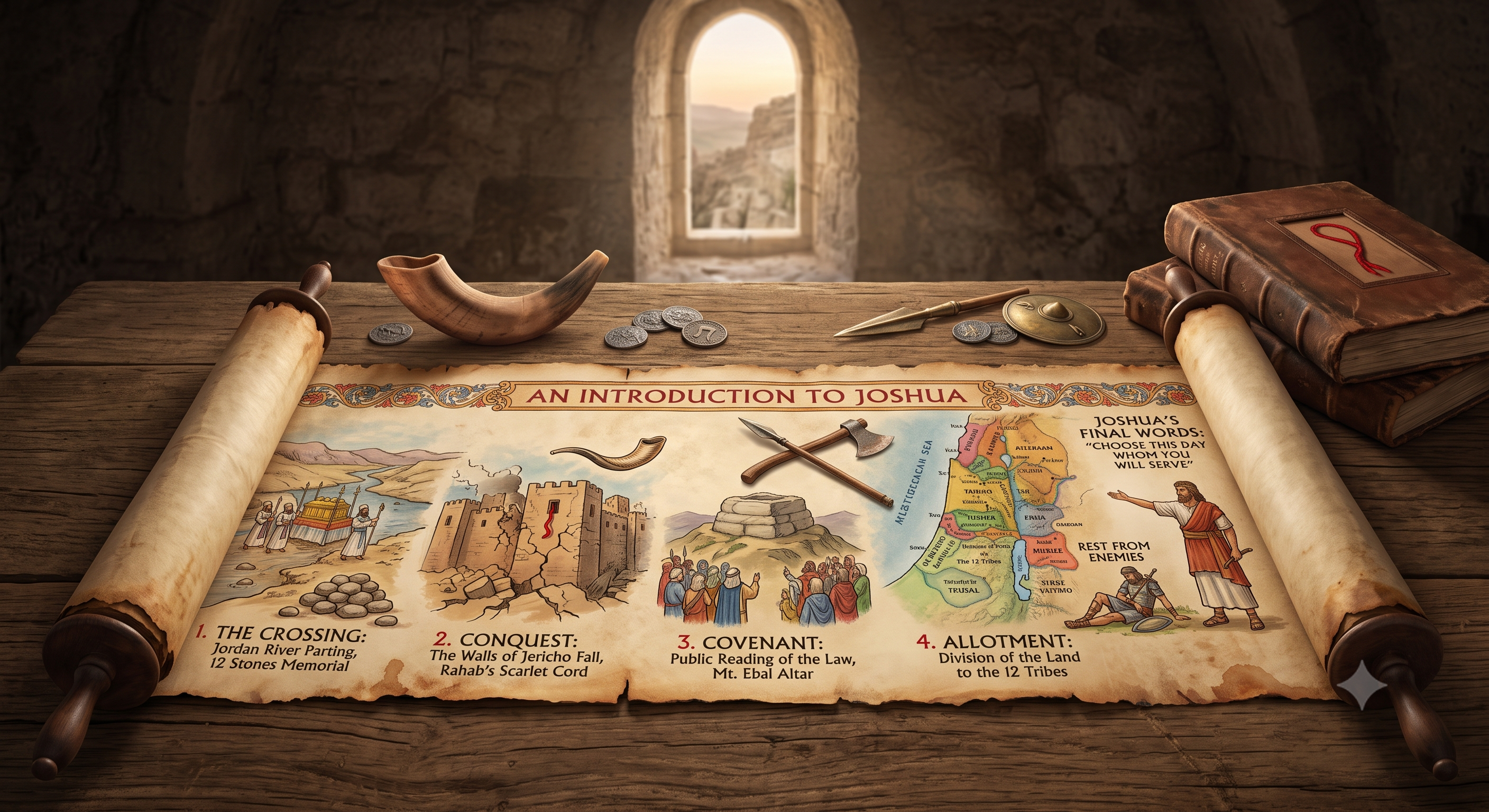
The Book of Joshua marks a major turning point in the biblical story. After generations of promise, wandering, and preparation, Israel finally enters the land pledged to Abraham. Joshua, Moses’ successor, leads the people through conquest, settlement, and covenant renewal. Yet Joshua is far more than a military chronicle. It is a theological narrative about God’s faithfulness, human responsibility, and the shaping of a community called to live under Yahweh’s rule.
Joshua bridges two worlds: the wilderness era of the Pentateuch and the settled life of Israel in the land. It shows the initial fulfillment of God’s promises while also revealing the challenges of living faithfully in a new environment. The book invites readers to reflect on obedience, leadership, justice, and the enduring reliability of God’s word.
Outline of the Book of Joshua
1. Preparation and Entry into the Land (Joshua 1–5)
Joshua is commissioned as Israel’s new leader. The spies visit Rahab in Jericho, the people cross the Jordan River, and Israel renews its covenant identity through circumcision and Passover. The section ends with Joshua’s encounter with the “commander of Yahweh’s army.”
2. The Conquest of Canaan (Joshua 6–12)
This central portion narrates Israel’s military campaigns:
Central Campaign: Jericho falls, Ai is taken, and Israel renews the covenant at Mounts Ebal and Gerizim.
Southern Campaign: After the Gibeonite treaty, Joshua defeats a coalition of southern kings.
Northern Campaign: Israel overcomes northern alliances. A final list summarizes the defeated kings and territories.
3. Distribution of the Land (Joshua 13–21)
The narrative slows to describe how the land is apportioned among the tribes. Caleb receives his inheritance, the tribal boundaries are detailed, and the cities of refuge and Levitical towns are established. This section emphasizes that the promise of land is not abstract—it becomes concrete geography.
4. Covenant Life and Joshua’s Farewell (Joshua 22–24)
The eastern tribes return home, nearly causing a misunderstanding about worship. Joshua delivers two farewell speeches urging Israel to remain faithful. The book concludes with a covenant renewal at Shechem and the deaths of Joshua and Eleazar.
Major Themes in the Book of Joshua
1. God’s Faithfulness to His Promises
Joshua repeatedly affirms that God keeps His word. The land promised to Abraham is given, and the narrator emphasizes that “not one of all the good promises of Yahweh failed.” The book is a testimony to divine reliability.
2. Covenant Obedience
Victory in Joshua is not based on military strength but on faithfulness. Jericho falls through obedience; Ai initially resists Israel because of Achan’s sin. The book teaches that covenant loyalty is the foundation of Israel’s success.
3. Divine Warfare
Joshua presents Yahweh as the true warrior who fights for Israel. The encounter with the divine commander in chapter 5 reframes the battles as theological events—Israel participates in God’s war, not the other way around.
4. Judgment and Holiness
The conquest narratives reflect divine judgment on entrenched wickedness (cf. Gen 15:16). At the same time, Israel is warned that disobedience will bring similar consequences. Holiness is essential for life in the land.
5. Inclusion of Outsiders
Rahab, a Canaanite woman, becomes a model of faith and is incorporated into Israel. Her story anticipates the broader biblical theme that God’s grace extends beyond ethnic boundaries.
6. Unity of God’s People
Joshua stresses the unity of the tribes—crossing the Jordan together, fighting together, and resolving disputes together. The book envisions Israel as a single covenant community.
7. Land as Gift and Responsibility
The land is both a divine gift and a covenant trust. Israel must maintain justice, worship Yahweh alone, and avoid the idolatry of the nations. Possession of the land comes with ethical obligations.
Studies in the Book of Joshua
Shiloh: The Forgotten Sanctuary of Ancient Israel
Religious Commitment in Joshua 24:15
Translating the Bible: Translating Rare Words
Studies on The Long Day of Joshua
The Long Day of Joshua – Part 1
The Long Day of Joshua – Part 2
The Long Day of Joshua – Part 3
Standing Stones in the Old Testament
Standing Stones: Discovering God’s Greatness
Studies on Gregory Boyd and the Crucifixion of the Warrior God
The Ancient Canaanite Palace at Hazor
Greg Boyd and the Commander of the Army of Yahweh – Part 1
Greg Boyd and the Commander of the Army of Yahweh – Part 2
Solar Eclipses in the Old Testament
Rahab: A Prostitute or an Innkeeper?
Claude Mariottini
Emeritus Professor of Old Testament
Northern Baptist Seminary
If you enjoyed reading this post, you will enjoy reading my books.
VISIT MY AMAZON AUTHOR’S PAGE
BUY MY BOOKS ON AMAZON (Click here).
NOTE: Did you like this post? Do you think other people would like to read this post? Be sure to share this post on Facebook and share a link on X so that others may enjoy reading it too!
If you are looking for other series of studies on the Old Testament, visit the Archive section and you will find many studies that deal with a variety of Old Testament topics.